
Long Exposure Film Photography: Mastering Reciprocity Failure, Night Shots, and Light Trails
Quick Summary
Film loses sensitivity during long exposures due to reciprocity failure, requiring exposure time beyond what your meter indicates. In our experience developing thousands of long exposure rolls at Kubus Photo Service, a 10-second metered reading typically needs 30-60 seconds of actual exposure depending on the film stock. Each film has different reciprocity characteristics, with Fuji films generally handling long exposures better than Kodak. Black and white films typically require less compensation than color negative.
- Reciprocity failure begins around 1 second for most films; compensation increases exponentially
- Fuji Pro 400H and Acros 100 II have minimal reciprocity failure up to 120 seconds
- Kodak Portra needs significant compensation: 10 sec metered = 40-50 sec actual
- Color shifts occur during long exposures on color film; filtration or post-correction helps
- Use a sturdy tripod and cable release for exposures over 1 second
- Bracket extensively: shoot 2x and 4x your calculated exposure for safety
Long exposure photography on film involves a peculiarity that doesn't exist in digital capture: reciprocity failure. In our experience processing thousands of long exposure rolls, we've found that once you exceed about one second of exposure, your meter's reading becomes unreliable. Your light meter assumes a linear relationship between light intensity and exposure time. Double the time, double the exposure. This holds true for short exposures, but film stops playing by those rules during extended captures.
The crystals in film emulsion need a certain threshold of photons hitting them within a brief window to become developable. During long exposures, light arrives so gradually that some photons essentially don't count. The film's effective sensitivity drops, requiring increasingly longer exposures than your meter suggests. Why does this matter for your photography? Because without proper compensation, your night shots will consistently come back 1-3 stops underexposed.
Understanding and compensating for reciprocity failure transforms night photography from frustrating guesswork into a reliable creative practice. This guide covers the technical details, film-specific compensation, and practical techniques for creating compelling long exposures.
The Science of Reciprocity Failure
The reciprocity law states that exposure equals intensity multiplied by time. At ISO 400, f/8 for 1/500 second should equal f/8 for 1/250 second at ISO 200. This works perfectly for normal photography.
But film emulsion has a quirk. Silver halide crystals need multiple photon impacts within a short time window to reach the threshold for becoming a latent image. During very short exposures (high-speed flash) or very long exposures, photons arrive outside this optimal window. The result: the film acts slower than its rated speed.
For long exposures, this means you need progressively more time than your meter indicates. A one-stop increase in metered time doesn't necessarily produce a one-stop increase in exposure. The relationship becomes logarithmic rather than linear.
Why Digital Doesn't Have This Problem
Digital sensors accumulate charge continuously. Every photon counts equally whether it arrives in the first millisecond or the last minute of exposure. The only limit is sensor heat and noise, which is why digital cameras can shoot arbitrarily long exposures limited only by battery life and noise accumulation.
Film's chemical process creates different constraints. Understanding this fundamental difference helps explain why film long exposure requires specific techniques.
Film-Specific Reciprocity Compensation
Every film stock has different reciprocity characteristics. Manufacturer data sheets provide compensation guidelines, but real-world testing often reveals different behavior. The following information combines published specifications with our observations from processing thousands of long exposure rolls at Kubus Photo Service.
Reciprocity Compensation Quick Reference Table
Portra 160 (1 sec metered: 1.5 sec) — 10 sec metered: 50 sec, 30 sec metered: 3 min, 60 sec metered: 7 min
Portra 400 (1 sec metered: 1.3 sec) — 10 sec metered: 40 sec, 30 sec metered: 2.5 min, 60 sec metered: 6 min
Portra 800 (1 sec metered: 1.2 sec) — 10 sec metered: 35 sec, 30 sec metered: 2 min
Kodak Gold 200 (1 sec metered: 2 sec) — 10 sec metered: 60 sec, 30 sec metered: Not recommended, 60 sec metered: Not recommended
Fuji Acros 100 II (1 sec metered: No comp) — 10 sec metered: No comp, 30 sec metered: No comp, 60 sec metered: 90 sec
Ilford HP5+ (1 sec metered: 1.3 sec) — 10 sec metered: 30 sec, 30 sec metered: 3 min, 60 sec metered: 7 min
CineStill 800T (1 sec metered: 1.5 sec) — 10 sec metered: 40 sec, 30 sec metered: 2.5 min
Kodak Portra Films (160, 400, 800)
Kodak Portra films show moderate reciprocity failure starting around 1 second. We've seen these patterns consistently:
Portra 160:
- 1 second metered: 1.5 seconds actual
- 10 seconds metered: 50 seconds actual
- 30 seconds metered: 3 minutes actual
- 60 seconds metered: 7 minutes actual
Portra 400:
- 1 second metered: 1.3 seconds actual
- 10 seconds metered: 40 seconds actual
- 30 seconds metered: 2.5 minutes actual
- 60 seconds metered: 6 minutes actual
Portra 800:
- 1 second metered: 1.2 seconds actual
- 10 seconds metered: 35 seconds actual
- 30 seconds metered: 2 minutes actual
Portra 800's faster base speed means you're less likely to need extreme exposure times, making it practical for night work even with its reciprocity failure.
Kodak recommends CC filters for exposures beyond 10 seconds to correct color shift. A CC10Y (yellow) filter helps neutralize the cyan cast that develops. However, many photographers embrace the color shift as part of the night photography aesthetic.
Kodak Gold and Ultramax
Consumer Kodak films have more pronounced reciprocity failure than professional stocks. What actually happens with these films during long exposures can be unpredictable.
Kodak Gold 200:
- 1 second metered: 2 seconds actual
- 10 seconds metered: 60 seconds actual
- Beyond 10 seconds: not recommended (severe color shifts)
Kodak Ultramax 400:
- 1 second metered: 1.5 seconds actual
- 10 seconds metered: 45 seconds actual
- Beyond 10 seconds: unpredictable results
These films can produce interesting results for night photography, but expect significant magenta or cyan color casts that may or may not work for your vision. A common mistake we see is photographers pushing these consumer films beyond 30 seconds expecting consistent results.
Fuji Color Negative Films
Fuji films historically showed less reciprocity failure than Kodak equivalents. While Fuji has discontinued most color negative films, you may still find expired stock or occasional limited releases.
Fuji Pro 400H (discontinued, but still circulating):
- 1 second metered: 1.1 seconds actual
- 10 seconds metered: 15 seconds actual
- 60 seconds metered: 90 seconds actual
- 120 seconds metered: 3.5 minutes actual
Pro 400H was legendary for long exposure work. Its minimal reciprocity failure and neutral color maintenance made it the professional choice for architectural and night photography.
Fuji Superia 400:
- 1 second metered: 1.3 seconds actual
- 10 seconds metered: 30 seconds actual
- Beyond 30 seconds: color shifts become significant
CineStill 800T
CineStill 800T (tungsten-balanced motion picture stock) has become popular for night photography despite not being designed for long exposures.
- 1 second metered: 1.5 seconds actual
- 10 seconds metered: 40 seconds actual
- 30 seconds metered: 2.5 minutes actual
The halation (red glow around highlights) that CineStill is known for becomes more pronounced during long exposures as light spreads through the emulsion over time. This can create striking effects around streetlights and neon signs, though it's not always predictable.
Black and White Films
Black and white films generally handle long exposures better than color, with simpler compensation and no color shift concerns. Have you ever wondered why so many classic night photographs were shot on black and white? This is a big reason.
Ilford HP5+:
- 1 second metered: 1.3 seconds actual
- 10 seconds metered: 30 seconds actual
- 60 seconds metered: 3 minutes actual
- 120 seconds metered: 7 minutes actual
Ilford Delta 100:
- 1 second metered: no compensation needed
- 10 seconds metered: 12 seconds actual
- 60 seconds metered: 80 seconds actual
- 300 seconds metered: 8 minutes actual
Kodak Tri-X:
- 1 second metered: 1.5 seconds actual
- 10 seconds metered: 35 seconds actual
- 60 seconds metered: 4 minutes actual
Kodak T-Max 100:
- 1 second metered: 1.1 seconds actual
- 10 seconds metered: 15 seconds actual
- 60 seconds metered: 1.5 minutes actual
- 300 seconds metered: 10 minutes actual
Fuji Acros 100 II: This film was specifically engineered for minimal reciprocity failure.
- Up to 120 seconds metered: no compensation needed
- 120-1000 seconds metered: add 1/2 stop
Acros 100 II is the best choice for extreme long exposures in black and white. Its reciprocity characteristics are genuinely exceptional.
Mail-In Your Film From Anywhere
Ship your film to our Brooklyn lab and get professional scans delivered to your inbox. Free shipping on 4+ rolls.
Equipment for Long Exposure
Tripod Requirements
Long exposure demands absolute stability. During a 5-minute exposure, any vibration records as blur. A heavy, sturdy tripod matters more than for any other type of photography.
Here's what we recommend:
- Weight capacity: At least 2x your camera/lens weight (e.g., 10+ lbs capacity for a 5 lb setup)
- Material: Carbon fiber reduces vibration; aluminum is more affordable
- Leg locks: Twist locks are faster; flip locks are more secure
- Center column: Avoid extending it, which introduces instability
- Price range: for a reliable long exposure tripod
Avoid extending the center column, which introduces instability. Use the lowest height that achieves your composition. On soft ground, let the tripod settle for a few minutes before beginning the exposure.
Hang your camera bag from the tripod center for additional stability, but ensure it doesn't swing in the wind.
Cable Releases and Remote Triggers
Touching the camera during exposure causes vibration. A mechanical cable release or electronic remote trigger is essential. Most cable releases cost between and last for years.
For exposures beyond 30 seconds, you'll need a locking cable release that holds the shutter open. Bulb mode requires constant shutter button pressure; the lock lets you step away.
If you don't have a cable release, use the self-timer to trigger the shutter after you've stepped away from the camera. This works for timed exposures but not for bulb mode.
Filters for Daytime Long Exposures
Neutral density filters extend exposure times enough to use long exposure techniques in daylight. A 10-stop ND filter turns a 1/125 second exposure into 8 seconds.
Common ND filter strengths:
- ND 3 (3 stops): 1/125 becomes 1/15 second
- ND 6 (6 stops): 1/125 becomes 1/2 second
- ND 10 (10 stops): 1/125 becomes 8 seconds
- ND 15 (15 stops): 1/125 becomes 4 minutes
When stacking multiple filters, be aware of potential color casts and vignetting. Higher-quality glass filters () produce more neutral results than cheap alternatives ().
Lens Selection
Wide-angle lenses suit many long exposure subjects: cityscapes, architecture, star trails. They also show less camera shake than telephoto lenses, which magnify any vibration.
Prime lenses generally perform better than zooms for long exposures. The simpler optical formula produces cleaner results during extended captures, and faster maximum apertures give you more flexibility in balancing exposure variables.
Night Photography Techniques
Metering in Low Light
Most in-camera meters struggle in very low light. Spot metering helps isolate specific brightness zones, but you may need external metering solutions for accurate readings.
A dedicated light meter with low-light capability (like the Sekonic L-858D at around ) can read much dimmer conditions than camera meters. Some photographers use smartphone apps as supplementary meters, though accuracy varies.
In extremely dark conditions, bracket extensively. If your calculated exposure is 4 minutes, also shoot 2 minutes and 8 minutes. Long exposure work consumes relatively few frames since each shot takes so long, so bracketing costs little extra film.
Exposing for Urban Night Scenes
City scenes typically contain extreme contrast: bright streetlights, illuminated signs, and deep shadows. You cannot capture full detail in both extremes. What's the best approach for your specific scene?
Decide what matters most. Exposing for shadow detail creates dramatic blown highlights where lights become radiating stars. Exposing for highlights preserves neon signs and lit windows but loses shadow information.
A middle approach exposes for midtones and accepts some loss at both extremes. Negative film's latitude helps recover information in both directions during scanning, especially if you communicate your intent to the lab.
Light Trails from Traffic
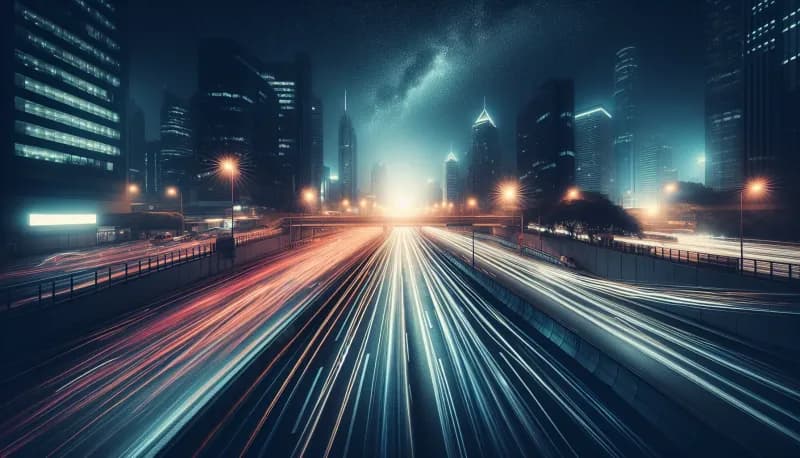
Moving vehicles create light trails when headlights and taillights streak across the frame during long exposures. Exposure length determines trail length.
- 2-5 seconds: Short dashes, vehicles still somewhat visible
- 10-30 seconds: Continuous trails, multiple vehicles blend together
- 1-5 minutes: Thick, saturated trails as many vehicles accumulate
Position yourself where traffic moves consistently. Curves create more dynamic trails than straight roads. Elevated positions looking down at intersections or highways produce classic light trail images.
Red taillights and white/yellow headlights appear as different-colored streaks moving in opposite directions. This contrast adds depth to the image.
Star Trails
Earth's rotation causes stars to move across the sky. Exposures of 20-30 minutes show short arcs; multi-hour exposures create complete circles around the celestial pole.
The formula for visible star trails: stars move 15 degrees per hour (360 degrees divided by 24 hours). A 30-minute exposure captures 7.5 degrees of arc.
For single-frame star trails, you need very dark skies away from light pollution. Even moderate light pollution overwhelms the faint star trails.
The North Star (Polaris) sits near the celestial pole, so star trails circle around it without significant movement. Composing with Polaris in frame creates the classic circular star trail pattern.
Film handles multi-hour exposures better than digital because there's no sensor heat noise accumulation. Acros 100 II or Delta 100 can expose for hours with minimal reciprocity compensation compared to the base exposure time.
Moon Exposures
The full moon is surprisingly bright, reflecting direct sunlight. The classic "loony 11" rule suggests f/11 at 1/ISO for a properly exposed moon.
At ISO 100, a full moon exposes correctly at f/11 at 1/100 second. At ISO 400, that's f/11 at 1/400 second. No reciprocity compensation needed since these are short exposures.
The challenge: properly exposing the moon leaves everything else black. Including landscape with the moon requires either:
- Separate exposures composited in post
- Long exposure for landscape with moon trail (moon moves visibly during exposures over 30 seconds)
- Twilight timing when ambient light balances with moonlight
Creative Long Exposure Techniques
Water Movement
Long exposures transform moving water into smooth, ethereal surfaces. Waves become fog, waterfalls become silk, rivers become glass.
- 1/4 to 1 second: Partial blur, water still shows movement direction
- 1-5 seconds: Heavy blur, water texture smooths significantly
- 30+ seconds: Complete smoothing, water becomes featureless surface
The effect depends on how fast the water moves. Slow rivers need longer exposures than crashing waves to achieve similar smoothing.
Use ND filters during daylight to achieve these exposure times. Without filtration, bright conditions force apertures so small that diffraction degrades image quality.
Cloud Streaking
Clouds move slowly enough that exposures of 30 seconds to several minutes show visible streaking. The effect works best with partly cloudy skies where streaks contrast against blue.
Fast-moving storm clouds streak dramatically in shorter exposures. Gentle cirrus clouds need longer times to show visible movement.
Architectural Light Painting
During extended exposures, walk through the scene with a flashlight or strobe, selectively illuminating portions of buildings or landscapes. The light appears in the image while you remain invisible (assuming you keep moving and don't illuminate yourself).
This technique works for abandoned buildings, ancient ruins, or any subject where natural light doesn't reveal the detail you want. Multiple passes with different colored lights create complex layered illumination.
Multiple Exposures During Long Exposure
Cover the lens (with a hat or dark card, not your hand which might show) mid-exposure, recompose, then uncover to continue. This allows multiple "frames" within a single long exposure.
The technique works for self-portraits where you appear multiple times, or for capturing different phases of an event within one frame.
Processing Considerations
Development Adjustments
Some photographers adjust development time for extreme long exposures to control contrast. Long exposures can produce higher-than-normal contrast as highlight densities build.
For black and white film, pull processing (reduced development time) can tame contrast from very long exposures. A 10% development reduction helps balance negatives from exposures over 10 minutes.
Color negative processing follows standard C-41 chemistry with no modifications. Any contrast control happens during scanning.
Scanning Long Exposure Negatives
Long exposure negatives may have unusual density distributions. Automated scanning settings optimized for normal exposures might clip highlights or crush shadows in ways that lose the specific qualities you captured.
Communicate with your lab about your long exposure work. At Kubus Photo Service, we note when frames appear to be intentional long exposures and adjust scanning accordingly rather than applying standard corrections that would normalize the distinctive characteristics.
Dealing with Grain and Noise
Long exposures don't increase grain the way raising ISO does. The grain structure of your chosen film remains consistent regardless of exposure length.
However, very underexposed areas (deep shadows at the edge of the exposure) may show more visible grain as the scanner works harder to extract information from thin negative density. Proper reciprocity compensation minimizes this by ensuring adequate exposure throughout the frame.
Troubleshooting Common Problems
Images Too Dark
Even with reciprocity compensation, images often come back darker than expected. The compensation charts provide starting points, but variation between film batches, meter calibration, and subject brightness affects results.
Solution: Add additional compensation beyond published guidelines. If your images consistently come back one stop dark, add that stop to future calculations.
Color Shifts
Long exposures on color film produce color shifts as different emulsion layers respond differently to extended exposure. Cyan, magenta, and green casts are common.
Solutions:
- Accept the shift as part of the aesthetic
- Use color correction filters during capture (CC10Y for cyan cast, etc.)
- Correct during scanning or post-processing
- Choose films known for minimal color shift (discontinued Fuji Pro 400H was best; current Portra handles it reasonably)
Hot Spots and Uneven Exposure
Some cameras develop hot spots from sensor heat or light leaks during very long exposures. Film cameras don't have sensor heat, but light leaks become more apparent during extended captures.
Check your camera's light seals if you see consistent fogging or light streaks. Older cameras often need seal replacement every 10-15 years.
Star Trails When You Wanted Points
If you wanted sharp star points but got short trails, your exposure was too long for the focal length. The 500 rule provides guidance: divide 500 by your focal length for maximum exposure time in seconds before trails appear.
- 50mm lens: 500/50 = 10 seconds maximum
- 24mm lens: 500/24 = 21 seconds maximum
- 200mm lens: 500/200 = 2.5 seconds maximum
Practice Exercises
Exercise 1: Reciprocity Calibration
Shoot a test roll at twilight with progressively longer exposures. Start at 1 second and double each frame: 1, 2, 4, 8, 16, 32 seconds, 1, 2, 4, 8 minutes. Apply published reciprocity compensation.
When you get results back, note which frames are properly exposed. This calibrates your specific film stock, meter, and technique combination.
Exercise 2: Traffic Study
Find an intersection with consistent traffic. Set up your tripod and shoot the same composition at multiple exposure lengths: 5, 15, 30, 60, 120 seconds. Compare how trail characteristics change.
Exercise 3: Water Comparison
At a waterfall or wave-crashed shore, shoot the same scene at 1/500 second (freezing motion), 1/15 second (partial blur), 1 second, 10 seconds, and 1 minute (with ND filter). Compare the different interpretations of movement.
Getting Your Long Exposures Developed
Long exposure negatives don't require special processing chemistry, but they benefit from careful attention during scanning. The unusual density ranges and potential color shifts need thoughtful interpretation rather than automated correction.
When submitting film with long exposure work, include a note mentioning which frames are intentional long exposures. This helps us at Kubus Photo Service understand that unusual characteristics are intentional rather than errors to correct.
Our standard turnaround runs 4-6 business days depending on current volume. If you need results faster, we offer rush same-day and next-day service. All developing and scanning happens on professional Noritsu equipment capable of handling the full dynamic range of long exposure work.
Visit our mail-in film lab for shipping details, or learn more about our film developing and scanning services. We're also happy to answer questions about long exposure techniques when you submit your order.
Frequently Asked Questions
What is reciprocity failure and why does it matter?
Reciprocity failure is film's loss of sensitivity during long exposures. Below about one second, doubling exposure time doubles the effect on film. Above one second, this relationship breaks down and you need increasingly more time than your meter indicates. Without compensating, your long exposures will be underexposed.
Which film is best for long exposures?
For black and white, Fuji Acros 100 II has exceptional reciprocity characteristics, requiring no compensation up to 120 seconds. For color, Fuji Pro 400H was the gold standard (now discontinued; hunt for fresh expired stock). Among current films, Kodak Portra 400 and 800 handle long exposures reasonably well with predictable compensation needs.
How do I meter scenes that are too dark for my camera's meter?
Use a dedicated light meter with greater low-light sensitivity. Alternatively, take a reading at a higher ISO (meter as if you're shooting ISO 6400), then calculate the actual exposure for your film's ISO. You can also spot meter bright elements in the scene and calculate overall exposure from those reference points.
How long can I expose film before it fails completely?
Most films can produce acceptable results with exposures of several hours, though reciprocity compensation becomes extreme. Acros 100 II has been used successfully for exposures up to 24 hours for astronomical work. The practical limit depends more on your patience and the ambient light stability than on film capability.
Why do my night photos have strange color casts?
Color shifts during long exposure occur because the three emulsion layers (cyan, magenta, yellow) have different reciprocity characteristics. They stop responding at different rates during extended exposure. Color correction filters during capture can compensate, or you can correct during scanning and editing.
Can I do long exposures without a cable release?
For timed exposures (where your camera controls the duration), use the self-timer to avoid touching the camera during the actual exposure. For bulb exposures requiring manual duration control, you need some form of remote trigger. Some photographers use gaffer tape to hold the shutter button, but this introduces vibration and isn't recommended.
Kubus Photo Service is a family-run film lab in Williamsburg, Brooklyn, developing film since 1994. We're a family-run lab that understands the specialized needs of creative film techniques. Questions about long exposure or any other aspect of film photography? Call us at (718) 389-1339.
Related Articles
Film for Concert Photography: Capturing Live Music in Extreme Low Light
Concert photography on film demands high-speed stocks, fast lenses, and push processing techniques. Here's how to capture the energy of live music when every photon counts.
CineStill 800T: The Complete Guide to Shooting Cinema Film in Still Cameras
CineStill 800T brings the look of Hollywood motion picture film to your still camera, complete with its signature halation glow and tungsten color balance. Here is everything you need to know to shoot it successfully.
The Sunny 16 Rule Explained: Master Film Exposure Without a Light Meter
The Sunny 16 rule has helped photographers nail exposure for over a century. Learn this time-tested technique for estimating light levels, plus variations for every lighting condition from beach to overcast to shade.
Ready to Develop Your Film?
We're a family-run film lab in Williamsburg, Brooklyn, developing film since 1994. Whether you drop off in store or mail your rolls from anywhere in the US, we treat every frame with care.
How to Mail In Film for Developing: Complete Step-by-Step Guide
Learn exactly how to safely mail your film for professional developing. Step-by-step guide covering packing, shipping options, what to expect, and how to get the best results from a professional film lab.
Read the Complete Guide