
Instant Film vs. Traditional Film: Pros, Cons, and Costs
Quick Summary
**Instant film costs .75 to .00 per shot and delivers immediate physical prints but with lower image quality (800x600 pixels).** Traditional 35mm film costs .40 to .00 per shot including developing, offers 15-25 megapixels of real optical resolution, and creates archival-quality negatives that can be reprinted indefinitely. In our experience, about 70% of photographers benefit from having both formats available for different situations.
- Instant film: .75- per shot, immediate print, lower resolution (~800x600 pixels), no negative backup
- Traditional 35mm: .40- per shot with processing, 15-25 megapixels of resolution, scannable negatives
- Instant excels at events, gifts, and social spontaneity where sharing matters more than quality
- Traditional offers archival quality, enlargement potential up to 16x20" prints, and creative control
- Wedding photographers often use both: Instax for guest guestbooks, traditional film for ceremony shots
- Instant film waste runs 15-20% higher due to misfires and no preview option
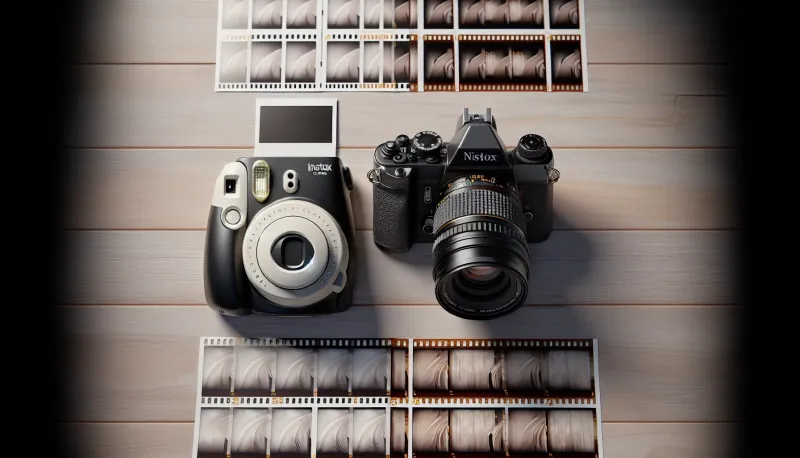
Two cameras sit on the table at a birthday party. One is a Fuji Instax Mini, loaded with instant film that will spit out credit-card-sized prints seconds after each shot. The other is a Canon AE-1 loaded with Kodak Portra 400, whose images won't exist until the roll gets developed days or weeks later.
The reality is that both formats serve completely different purposes, and over the years we've seen photographers waste hundreds of dollars trying to force one format to do another's job. Instant film delivers immediate gratification at .75-.00 per shot. Traditional film delivers superior quality at .40-.00 per shot including processing. Understanding when each makes sense saves you money and frustration.
Both are film cameras. Both create analog photographs using chemical processes and light-sensitive materials. But the shooting experience, the costs, the image quality, and the final output differ so dramatically that comparing them requires examining multiple dimensions.
This guide breaks down the practical differences between instant film and traditional film photography. Whether you're choosing between them, considering adding one to your existing practice, or simply curious about how they compare, you'll find detailed analysis here.
Understanding the Technologies
Instant film and traditional film share basic photographic principles but diverge dramatically in how they create final images. What actually happens inside each system explains why the results differ so much.
How Instant Film Works
Instant film contains everything needed to produce a finished print within the film pack itself. Each sheet includes light-sensitive layers, processing chemicals, and the final print substrate in one self-contained unit.
When you press the shutter, light exposes the light-sensitive layers. The camera ejects the film through rollers that break a pod of processing chemicals, spreading them between layers. Chemical reactions develop the image over the following 2-5 minutes as dyes migrate to form the visible photograph.
The magic happens automatically, requiring no darkroom, no lab, no external processing. But this convenience comes with constraints:
-
The image exists only as that single print
-
There's no negative to rescan or reprint
-
The chemical processes, compressed into a thin film pack, can't match the quality of traditional development in controlled lab conditions
-
Dynamic range is limited to 8-10 stops versus 12-14 stops for traditional film
Different instant film systems use different approaches. Polaroid's original integral film and modern Polaroid I-Type use a larger format with distinctive square prints. Fuji Instax comes in Mini (credit card size), Wide (4x6 equivalent), and Square formats with different print sizes.
How Traditional Film Works
Traditional film separates capture from output. The film in your camera contains light-sensitive silver halide crystals in a gelatin emulsion. Exposure creates a latent image in these crystals, invisible until chemical development.
Processing happens later in a lab (or home darkroom). Developer solution converts exposed silver halide to metallic silver, creating a visible negative image. Stop bath halts development. Fixer removes unexposed silver halide, stabilizing the image. Washing removes residual chemicals.
The result is a stable negative that can be:
-
Scanned to create digital files at various resolutions
-
Printed in a darkroom at any size
-
Stored indefinitely for future use
-
Reprinted decades later with no quality loss
That negative is the master, and any number of prints or scans can be made from it. At Kubus Photo Service, we've scanned negatives from the 1950s that still produce excellent results. Why does this matter? Because your memories aren't disposable.
This separation of capture and output allows optimization at each stage. Film chemistry can focus purely on recording light. Processing chemistry can be precisely controlled. Scanning and printing can be adjusted independently. The complexity creates opportunities for quality that integrated instant systems simply can't match.
Cost Comparison: The Real Numbers
Cost-per-shot analysis reveals dramatic differences between instant and traditional film. Understanding these economics helps you budget appropriately and avoid expensive surprises.
Instant Film Costs
Instant film pricing varies by format and brand:
Fuji Instax Mini Cost Per Shot: .70-.80 — Pack Price: (10 shots), Notes: Most affordable instant format
Fuji Instax Wide Cost Per Shot: .90-.10 — Pack Price: (20 shots), Notes: Larger 4x6" equivalent prints
Fuji Instax Square Cost Per Shot: .85-.00 — Pack Price: .50-10 (10 shots), Notes: Square format, Instagram-friendly
Polaroid I-Type/600 Cost Per Shot: .60-.00 — Pack Price: (8 shots), Notes: Classic Polaroid format
Polaroid SX-70 Cost Per Shot: .80-.20 — Pack Price: (8 shots), Notes: Special formulation for vintage cameras These costs represent the entire expense. No developing, no scanning, no additional fees. What you spend on film is what you spend total.
But that per-shot cost adds up quickly. A wedding with 100 Instax shots costs to in film alone. A year of casual shooting at five shots per week totals to . Heavy use becomes expensive fast.
Traditional Film Costs
Traditional film requires calculating both film and processing:
Film Cost (35mm, 36 exposures)
- Consumer stocks (Kodak Gold, Fuji C200): to per roll, or .22 to
- Professional stocks (Portra 400, Ektar): to per roll, or .39 to
- Specialty stocks (CineStill, Lomo): to per roll, or .42 to
Processing Cost (35mm)
- Develop only: to
- Develop plus standard scans: to
- Develop plus high-resolution scans: to
Total Cost Per Shot
- Budget approach (consumer film, standard scans): .22 film + .42 processing = .64 per shot
- Typical approach (pro film, high-res scans): .44 film + .64 processing = .08 per shot
- Premium approach (specialty film, max resolution): .50 film + .78 processing = .28 per shot
The numbers overlap with instant film in some scenarios but diverge at the extremes. Budget traditional shooting costs less than any instant format. Premium traditional shooting costs similar to Polaroid instant but delivers dramatically higher quality.
Hidden Cost Factors
The simple per-shot comparison misses important nuances:
Instant film waste: In our experience, misfires, bad exposures, and test shots run 15-20% higher than traditional film. With no preview and no do-overs, that waste rate significantly affects true cost-per-keeper.
Traditional film efficiency: You can meter carefully, wait for the right moment, and choose not to shoot when conditions are wrong. The delay before seeing results encourages thoughtfulness that reduces waste.
Prints from traditional: If you want physical prints from traditional film, add printing costs. Digital scans for screen use cost less than getting prints, but matching instant's physical output adds expense.
Enlargement potential: Traditional negatives can produce large prints. That .64 shot can become a stunning 16x20" print. Instant film's small format limits enlargement severely—we've seen customers try to blow up Instax prints and the results aren't pretty.
Mail-In Your Film From Anywhere
Ship your film to our Brooklyn lab and get professional scans delivered to your inbox. Free shipping on 4+ rolls.
Image Quality Differences
The quality gap between instant and traditional film is substantial and worth understanding before you invest in either system.
Resolution and Detail
Traditional 35mm film resolves 3,000 to 5,000 lines per inch depending on the stock. A well-scanned 35mm negative yields 15 to 25 megapixels of real optical resolution. Fine detail, texture, and subtle tonal gradations all survive.
Instant film operates at much lower resolution. The integral structure and self-processing chemistry limit fine detail:
- Instax Mini: 800x600 pixels of actual detail
- Instax Wide: 1200x800 pixels
- Polaroid: 1000x1000 pixels
This difference matters primarily for enlargement and digital use. Instant prints viewed at their native size look fine. But try to enlarge them past 5x7" or crop significantly and the limitations become painfully obvious.
Dynamic Range
Traditional film captures a wide range of brightness, typically 12 to 14 stops depending on the stock. Highlights can blow out, shadows can block up, but the latitude for exposure error and high-contrast scenes is substantial.
Instant film has more limited dynamic range, typically 8 to 10 stops. What actually happens in practice? High-contrast scenes often lose shadow or highlight detail. The compressed processing chemistry can't hold as much information.
Practically, this means traditional film handles challenging lighting better. Backlit subjects, harsh midday sun, and dramatic lighting all test instant film's limits more severely.
Color and Tonality
Modern instant films have improved dramatically from older versions, but traditional film still offers more accurate and controllable color.
Fuji Instax renders pleasant, slightly warm tones that work well for casual shooting. Polaroid produces the distinctive slightly desaturated, creamy look that defines the format's aesthetic. Both have character rather than accuracy.
Traditional film offers variety:
- Portra's neutral-warm skin tone rendering
- Ektar's vivid saturation and punchy colors
- CineStill's tungsten-balanced cinematic look
- Kodak Gold's warm, nostalgic palette
You choose the palette. And because negatives get scanned, color correction in post-processing provides additional control that instant simply can't match.
Black and white instant film exists but remains a niche product. Traditional black and white offers far more options, from classic Tri-X grain to smooth modern stocks like Delta 100.
Archival Stability
Properly stored traditional film negatives last indefinitely. We've seen photographs from the 1800s that remain scannable and printable today. Your negatives can outlast you.
Instant prints fade over time. Modern formulations have improved, but exposure to light, humidity, and temperature variations degrades the image. Decades-old Polaroids show color shift and fading. Careful storage helps but can't match traditional film's permanence.
For images you want to preserve long-term, traditional film's negative provides a stable archival master. Instant film's print is both original and only copy—a common mistake we see is people assuming they can just scan the instant print later, but that introduces another generation of quality loss.
Use Cases: When Each Format Shines
Rather than declaring one format superior, recognize that each excels in specific situations. The smartest photographers we've worked with use both.
Where Instant Film Wins
Parties and Events: Instant photos become gifts and mementos on the spot. Guests take home pictures immediately. The spontaneity creates social engagement that waiting for processing simply can't match.
Weddings and Gatherings: Set out an Instax camera and let guests photograph each other. The prints go into a guestbook or get taken home as favors. Traditional film can't replicate this immediate sharing. We recommend stocking 3-4 packs (30-40 shots) per 100 guests.
Photo Booths: The instant print format naturally suits booth-style shooting. Props, poses, immediate results, take-home memories. The lower quality matters less than the experience.
Gifts and Notes: Attach an instant photo to a gift or letter for personal touch. The unique physical object carries meaning beyond the image content.
Casual Documentation: Quick snapshots for informal records where quality isn't the point. What did the rental car look like when you picked it up? Instant photo, done.
Teaching and Demonstrations: Show someone how a camera works and produce a result immediately. The compressed timeline aids learning.
Where Traditional Film Wins
Serious Photography: Any situation where image quality matters calls for traditional film. Portraits, landscapes, street photography, documentation, art projects. The quality difference is substantial.
Archival Projects: Work you want to preserve for decades needs stable negatives. Family documentation, historical projects, and personal archives all demand traditional film's permanence.
Large Prints: Traditional negatives support significant enlargement—up to 16x20" or larger from 35mm, even bigger from medium format. Wall-sized prints, exhibition work, and commercial use all require the resolution traditional film provides.
Creative Control: Push processing, pull processing, cross-processing, and other creative techniques require traditional film. Instant film processes automatically with no variation possible.
Cost-Sensitive Volume: Shooting hundreds or thousands of frames makes traditional film's lower per-shot cost (with processing) more economical than instant.
Medium and Large Format: 120 film and large format sheet film offer even greater quality than 35mm. No instant equivalent exists at these quality levels.
Can You Have Both?
Many photographers use both formats for different purposes. The approaches are complementary rather than exclusive—and that's what we recommend for most serious shooters.
A wedding photographer might shoot the ceremony on medium format film for archival quality while providing guests an Instax camera for reception candids. The professional work gets professional treatment; the social sharing gets instant gratification.
A street photographer might carry a 35mm camera for serious work and an Instax Mini for giving portraits to subjects. The instant print becomes a gift and thank-you; the traditional shot becomes portfolio work.
The key is matching format to purpose rather than forcing one format to serve all needs.
Practical Considerations
Camera Options and Costs
Instant Cameras
- Fuji Instax Mini: to new. Simple operation, abundant film availability.
- Fuji Instax Wide: to . Larger prints, still affordable.
- Polaroid Now: to . Modern take on classic format.
- Vintage Polaroid SX-70: to used. Manual control, folding design, collector appeal.
Traditional Film Cameras
- Point and shoot (Olympus Stylus, Yashica T4): to depending on model and condition.
- SLRs (Canon AE-1, Nikon FM2): to . Manual control, interchangeable lenses.
- Medium format (Pentax 645, Mamiya 645): to . Superior quality, larger negatives.
- Rangefinders (Leica M6, Contax G2): to ,000. Premium build and optics.
Learning Curve
Instant cameras are simple. Point, shoot, wait for the print. Exposure is mostly automatic. Composition is what you see through the viewfinder or screen.
Traditional film cameras range from equally simple (point and shoot) to highly complex (manual focus SLRs, medium format systems). Basic operation is accessible, but mastering exposure, metering, and creative control takes time.
The bigger learning curve with traditional film isn't the camera but understanding the delay. You can't check your work immediately. Learning to trust your technique and accept the wait requires adjustment—but over the years, we've found this discipline actually makes better photographers.
Workflow Differences
Instant Workflow
- Shoot
- Wait 2-5 minutes for development
- Done (or scan the print if you want digital)
Traditional Film Workflow
- Shoot entire roll
- Send to lab or home develop
- Wait for processing (4-6 business days for lab, same day for home developing)
- Review scans or negatives
- Optional: print, edit, archive
The traditional workflow requires more planning and patience but offers more control at each stage. Professional labs like Kubus Photo Service can significantly streamline this process with proper handling and quick turnaround.
Making Your Choice
The right format depends on your goals:
Choose Instant If:
- Immediate physical prints matter more than image quality
- You shoot for social events, parties, and gatherings
- You want to gift photos on the spot
- You prefer simpler workflow without lab involvement
- Volume is low enough that cost per shot is acceptable (under 20 shots/month)
Choose Traditional Film If:
- Image quality is important
- You want archival negatives for long-term preservation
- You need enlargement potential for prints or digital use
- You shoot enough volume that per-shot economics matter (20+ shots/month)
- You want creative control over processing
Choose Both If:
- Different situations call for different approaches
- You can afford cameras and materials for both
- You want the unique benefits each format provides
Frequently Asked Questions
Which is cheaper in the long run, instant or traditional film?
Traditional film costs less per shot when you include processing, especially with consumer stocks and standard scans. Instant film's .75 to .00 per shot adds up faster than traditional's .40 to .00 including developing. However, instant has no processing lag or lab fees, so the total cost is known immediately. For shooters averaging 10+ rolls per year, traditional film typically saves 30-40% over equivalent instant shooting.
Can I scan instant photos to get digital files?
Yes, but quality is limited by the original print's resolution. Scanning an Instax Mini yields 800x600 useful pixels. You can scan for sharing or archives, but enlargement and editing potential is limited compared to traditional film scans from a professional lab.
Do professional photographers use instant film?
Some do, primarily for Polaroid proofing during shoots or for the unique aesthetic in creative work. But professional work requiring technical quality uses traditional film or digital. Instant film's limitations make it unsuitable for most professional applications where clients expect high-resolution deliverables.
Can I get prints from traditional film like instant film produces?
Yes. Labs can print 4x6 or smaller prints from traditional negatives. Home printing from scans is also easy. The prints will be higher quality than instant, though you wait for processing rather than getting them immediately.
Is instant film good for beginners learning photography?
Instant film teaches basic composition and timing with immediate feedback. Traditional film teaches the same fundamentals plus exposure discipline and delayed gratification. Both have learning value. Instant might be less frustrating initially, but traditional builds stronger technical foundations. We've seen beginners who started with instant often struggle more when transitioning to traditional film because they never learned to trust their settings without immediate confirmation.
How long do instant photos last compared to traditional prints?
Instant prints fade over decades, especially with light exposure. Traditional prints from negatives can last indefinitely with proper materials. More importantly, traditional negatives last essentially forever and can produce new prints anytime, while instant photos are one-of-a-kind with no backup.
The Best of Both Worlds
You don't have to choose exclusively. Many photographers keep an Instax Mini in the bag for social situations while shooting serious work on 35mm or medium format. The formats serve different purposes and coexist happily.
What matters is matching your tools to your intentions. Party snapshots to give away? Instant makes sense. Portfolio work you'll print large and keep forever? Traditional film delivers the quality and permanence you need.
At Kubus Photo Service, we process traditional film with care that maximizes the quality advantages the format offers. When you shoot on 35mm, 120, or other traditional formats, professional processing and scanning unlock the full potential of your negatives. We've been doing this in Brooklyn since 1994, and we understand what makes film special.
Explore our film developing services or start a mail-in order to experience the difference professional lab work makes.
Kubus Photo Service has provided professional film developing in Brooklyn since 1994. We process 35mm, 120, and other traditional film formats with the quality your images deserve.
Related Articles
How Much Does Film Developing Cost in 2026? Complete Price Guide
Film developing costs $12-25 per roll in 2026. Get the complete breakdown of drugstore vs. professional lab pricing for 35mm, 120, disposable cameras, and black and white film with honest advice on where to spend and where to save.
Best Film for Beginners: The Honest Guide from 30 Years Behind the Counter
After developing film for beginners since 1994, we've seen every mistake and every triumph. Here's our no-nonsense guide to choosing your first film stocks, avoiding expensive pitfalls, and building a foundation that actually works.
Wedding Disposable Cameras: The Complete Planning, Placement, and Developing Guide
Wedding disposable cameras capture candid moments your photographer misses. This complete guide covers camera selection, quantity formulas, strategic placement, guest instruction cards, collection logistics, and professional developing tips from a lab that has processed thousands of wedding disposables since 1994.
Ready to Develop Your Film?
We're a family-run film lab in Williamsburg, Brooklyn, developing film since 1994. Whether you drop off in store or mail your rolls from anywhere in the US, we treat every frame with care.
How to Mail In Film for Developing: Complete Step-by-Step Guide
Learn exactly how to safely mail your film for professional developing. Step-by-step guide covering packing, shipping options, what to expect, and how to get the best results from a professional film lab.
Read the Complete Guide