
Half-Frame Film Photography: Double Your Shots, Discover a Different Rhythm
Quick Summary
Half-frame cameras shoot images at half the size of a standard 35mm frame, producing vertical images and doubling shots per roll. The reality is this format offers incredible economy - you'll spend 50% less per image on film costs. In our experience scanning half-frame at Kubus Photo Service since the format's heyday in the 1960s, we've found the smaller negative still produces excellent results for web use, social media, and prints up to 5x7 inches.
- 72 exposures on a 36-shot roll, 48 on a 24-shot roll
- Native format is vertical (portrait orientation)
- Resolution is half of full-frame 35mm, limiting print sizes to 8x12" maximum for sharp results
- Creates natural diptych pairings from sequential shots
- Request half-frame scanning when submitting to your lab
- Best cameras: Olympus Pen EE-3 (), Canon Demi (), Konica AA-35 ()
Half-frame photography offers something rare in the film world: more shots for less money. By exposing half the standard 35mm frame area (18mm x 24mm versus 24mm x 36mm), half-frame cameras give you 72 images from a single 36-exposure roll. But economy is only part of the appeal. The format's vertical native orientation, natural diptych pairings, and compact camera designs have drawn photographers for over sixty years.
At Kubus Photo Service, we've scanned half-frame rolls since the format's heyday in the 1960s and continue to see renewed interest today. This guide covers everything from camera selection to scanning specifications, with practical advice on making the most of this unique format.
Understanding the Half-Frame Format
A standard 35mm frame measures 24mm x 36mm. Half-frame cameras divide this space in half, creating two frames of approximately 18mm x 24mm each. The film advances half the distance between exposures, yielding twice as many images per roll.
The math is simple: a 24-exposure roll becomes 48 exposures, a 36-exposure roll becomes 72. For photographers conscious of film costs, this effectively cuts per-image costs in half - from .50-0.75 per frame down to .25-0.40.
But the format does more than save money. Have you ever felt constrained by how quickly you burn through a roll? The smaller frame creates a different relationship with image making. You can shoot more freely, experiment without worrying about wasting frames, and create natural pairs and sequences. The vertical orientation changes how you compose, pushing you toward portrait-oriented images even when shooting street scenes or landscapes.
A Brief History of Half-Frame
Half-frame cameras emerged in the late 1950s and peaked in popularity during the 1960s and early 1970s. The format was developed primarily by Japanese manufacturers seeking to make photography more economical and cameras more compact.
Olympus Pen Series
Olympus introduced the Pen in 1959, designed by the legendary Yoshihisa Maitani. The original Pen was remarkably compact, featuring a fixed 28mm f/3.5 lens (equivalent to approximately 40mm on full-frame in terms of angle of view). It was purely mechanical, required no batteries, and fit easily in a pocket.
The Pen line expanded dramatically over the following decade:
Pen EE Series: Added automatic exposure using a selenium meter. The EE, EES, and EE-2 models offered point-and-shoot convenience with automatic aperture selection.
Pen D Series: Semi-automatic and fully manual options for photographers wanting more control. The Pen D through D3 offered various lens and metering combinations.
Pen F System: An interchangeable-lens SLR in half-frame format. The Pen F (1963), Pen FT (1966), and Pen FV (1967) accepted a range of dedicated lenses from 20mm to 800mm. The half-frame SLR system was unique, offering system-camera capability in a package far smaller than full-frame SLRs.
Canon Half-Frame Cameras
Canon Demi: Introduced in 1963, the Demi featured a sharp 28mm f/2.8 lens (later models had a 30mm) and a classic rangefinder design. The Demi line included zone-focus and coupled-rangefinder variants.
Canon Dial 35: A distinctive camera with the shutter release on the back and a rotating bezel for winding film. Its 28mm f/2.8 lens and clockwork-based advance mechanism made it unusual but popular.
Other Notable Half-Frame Cameras
Konica AA-35 (Auto S Half): An autoexposure half-frame with a 25mm f/2.8 lens, known for sharp optics and compact design.
Yashica Half Cameras: Yashica produced several half-frame models including the Yashica Half, Rapide, and Sequelle.
Ricoh Caddy: A compact half-frame with automatic exposure.
Agfa Parat/Paramat: European entries into the half-frame market.
The format declined after the 1970s as 35mm point-and-shoot cameras became smaller and film became relatively less expensive. But many half-frame cameras survive in working condition, and the format has seen renewed interest among film photographers.
Half-Frame Camera Buying Guide
If you're interested in shooting half-frame, here's what to look for in a camera. We recommend starting with one of these proven options.
Half-Frame Camera Comparison
Olympus Pen EE-3 — Lens: 28mm f/3.5, Features: Auto exposure, no battery needed, Best For: Beginners, reliability
Olympus Pen F — Lens: Interchangeable, Features: SLR, manual control, Best For: Serious photographers
Canon Demi — Lens: 28mm f/2.8, Features: Rangefinder focus, Best For: Sharp images, compact
Konica AA-35 — Lens: 25mm f/2.8, Features: Auto exposure, Best For: Exceptional lens quality
Yashica Half 17 — Lens: 32mm f/1.7, Features: Fast lens, Best For: Low light, budget option
Olympus Pen Series (Recommended)
The Pen EE-3 is probably the best entry point. It offers automatic exposure, a sharp 28mm f/3.5 lens, and reliable mechanical construction. Prices have risen with the film photography revival but remain reasonable compared to premium full-frame rangefinders.
The Pen F SLR system is excellent if you want creative control and interchangeable lenses, but prices have increased significantly. A body plus standard lens runs several hundred dollars for a working example.
All mechanical Pen cameras (everything except the Pen EF, which had flash capability) require no batteries, making them reliable for long-term use.
Canon Demi
The Demi offers sharp optics and elegant design. The rangefinder-coupled versions allow precise focusing, while simpler models use zone focusing. Build quality is excellent, and working examples remain available.
Konica AA-35
Often overlooked, the AA-35 has a reputation for exceptional lens quality. Over the years, we've seen consistently sharp results from this camera. It's a good choice if you can find one in working condition, though parts and repair services are harder to find than for Olympus.
What to Check When Buying
- Shutter Function: Fire the shutter at all speeds and listen for consistency. Slow speeds should sound distinctly slower
- Meter Operation: For auto-exposure cameras, check that the meter responds to light changes. Many use selenium cells that can degrade over 50+ years
- Lens Condition: Check for scratches, haze, and fungus. Front element cleaning marks are common but rarely affect image quality
- Film Transport: Ideally, run a test roll to confirm consistent frame spacing. Some cameras develop transport issues that cause overlapping frames
- Viewfinder Clarity: Dim or hazy viewfinders are common in older cameras. This doesn't affect image quality but makes composition difficult
Mail-In Your Film From Anywhere
Ship your film to our Brooklyn lab and get professional scans delivered to your inbox. Free shipping on 4+ rolls.
Shooting Half-Frame: Practical Considerations
The Vertical Default
Half-frame cameras produce vertical images when held normally (horizontally). This takes adjustment if you're accustomed to horizontal compositions. Street scenes, landscapes, and many traditional subjects suddenly become vertical. Isn't that a refreshing change from the usual horizontal default?
You can turn the camera 90 degrees to shoot horizontal images, but this feels awkward with most half-frame cameras, which weren't designed to be held vertically.
Many half-frame photographers embrace the vertical format rather than fighting it. Portraits, urban canyons, tall buildings, and figure-in-landscape compositions all work well in vertical orientation.
Thinking in Pairs
Because two half-frames occupy the space of one full frame, adjacent images become natural pairs when viewed on the film strip or contact sheet. This creates opportunities for diptych presentations.
Some photographers exploit this deliberately, composing consecutive shots as left/right or before/after pairs. Others shoot freely and discover unexpected pairings when reviewing their work. Either approach can yield interesting results.
The 72-Shot Roll
Having 72 frames changes your shooting rhythm. You're less hesitant to experiment, to take multiple versions of a shot, or to photograph something just because it's interesting. Film economy encourages exploration rather than conservation.
But 72 frames also means longer time between development. A roll might represent several weeks of shooting rather than a single outing. Keep notes or bracket your shooting sessions with identifiable frames if you need to track when and where you shot.
Resolution and Print Size
The half-frame image area is half that of full-frame 35mm: about 432 square millimeters versus 864. This means half the resolution for the same film and lens quality. The reality is that this limits how large you can print.
For web use, social media, and small prints (up to 5x7 inches), this limitation is negligible. A well-exposed half-frame negative scans beautifully and looks great on screen.
For larger prints, resolution becomes a consideration. An 8x12 print from half-frame is equivalent to a 12x18 print from full-frame in terms of pixel density. You can print larger, but sharpness and grain become more apparent.
Lens Quality Matters More
Because you're working with a smaller image area, lens sharpness becomes more critical. A common mistake is using a budget half-frame camera with a mediocre lens and expecting full-frame results. Any softness or aberration takes up a larger percentage of the already-limited resolution. The better half-frame cameras (Pen F series, Demi, Konica) had excellent optics designed specifically for the format.
If you're using a lesser-known half-frame camera, test it before committing to important projects. Some budget half-frame cameras had mediocre lenses that barely sufficed for snapshots.
Film Selection for Half-Frame
Film choice matters with half-frame because you're enlarging a smaller negative area.
Fine-Grain Films
Films with finer grain structure maximize sharpness when enlarged. These are our top recommendations:
- Kodak Ektar 100 - Finest grain color negative, exceptional sharpness
- Fuji Superia 200 - Good balance of grain and speed
- Kodak Gold 200 - Budget-friendly, fine grain for the price
- Ilford Pan F Plus 50 - Ultra-fine grain black and white
- Ilford Delta 100 - Modern T-grain technology
ISO Considerations
Lower ISO films generally have finer grain, but half-frame cameras often have modest maximum apertures (f/2.8 to f/3.5 for most fixed-lens models). Balance grain considerations against the need for adequate shutter speeds.
ISO 200 is a good general-purpose choice for half-frame. ISO 400 is fine for low light but shows more grain in enlargement. ISO 800 and above show significant grain in half-frame but can be aesthetically appealing.
Color vs. Black and White
Both work well in half-frame. Color films emphasize the grain structure more than black and white when enlarged. Black and white grain is often considered more pleasing and can be a deliberate aesthetic choice.
Slide Film
Positive (slide) film works well in half-frame, though the small image size makes projection less impactful than full-frame slides. Scanning slide film produces excellent results, and the inherent contrast of E-6 film can help half-frame images appear sharper.
Scanning Half-Frame Film
Half-frame requires specific attention during scanning. Not all labs automatically recognize half-frame format, and the scanning workflow differs from full-frame 35mm.
Identifying Half-Frame to Your Lab
When submitting half-frame film, clearly mark the order as half-frame. Labs that don't expect it may scan only every other image (treating pairs as single full frames) or produce incorrectly cropped scans.
At Kubus Photo Service, we recognize half-frame format and scan accordingly. Note it on your order form when submitting through our mail-in film lab, and we'll handle the scanning appropriately.
Scanning Options
Individual Frame Scanning: Each half-frame is scanned separately, producing 72 (or 48) individual vertical images from your roll. This is the standard approach and what most photographers want.
Diptych/Pair Scanning: Adjacent half-frames are scanned together as a single horizontal image, preserving the natural pairing. This works well for presentation but reduces flexibility in cropping and individual image use.
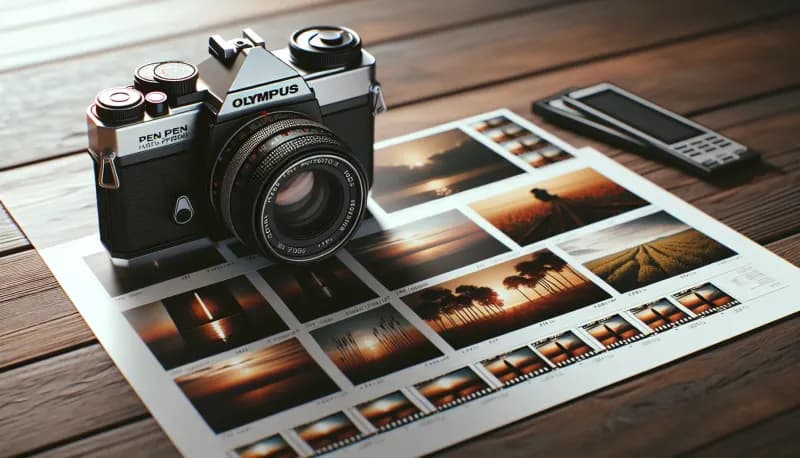
Strip Scanning: The entire film strip is scanned, showing multiple half-frames in sequence with sprocket holes and rebate visible. This creates a contact-sheet style presentation.
Specify your preference when ordering. The default at most labs is individual frame scanning.
Resolution Considerations
A half-frame negative holds less information than a full frame, so even at high scanner resolution, the output file is inherently limited. Our standard scans produce files appropriate for web use and moderate printing from half-frame.
For maximum enlargement, request high-resolution scans or consider drum scanning for critical images. But recognize that half-frame has inherent resolution limits that no scanner can exceed.
Dust and Scratches
The smaller frame size makes dust and scratches more prominent proportionally. A single dust speck that's barely visible on a full-frame scan becomes noticeable on half-frame. Handle negatives carefully and consider Digital ICE or similar dust removal if your lab offers it.
Creative Applications of Half-Frame
Documentary and Street Photography
The compact size of half-frame cameras and the economy of 72 shots per roll make the format ideal for documentary work. You can shoot extensively without worrying about running out of film, and the small cameras are unobtrusive.
The vertical orientation suits street photography, where vertical subjects (people, buildings, signage) are common. Many street photographers find the half-frame format encourages a more spontaneous, higher-volume shooting style.
Diptych Projects
The natural pairing of adjacent frames invites diptych explorations. Some approaches:
- Narrative Pairs: Shoot consecutive images that tell a mini-story: cause/effect, before/after, question/answer
- Contrast Pairs: Juxtapose opposites: old/new, light/dark, motion/stillness
- Visual Rhymes: Pair images with similar forms, colors, or compositions
- Random Juxtaposition: Shoot without planning and discover unexpected connections between adjacent frames
Sequence Work
With 72 frames, you can document processes, movements, and changes over time more thothan with 24 or 36 frames. The half-frame format suits time-lapse projects, event documentation, and sequential storytelling.
Travel Photography
The economy and compactness of half-frame make it appealing for travel. A single 36-exposure roll can document an entire trip, and the small cameras travel easily. The limitation on print size matters less when images are primarily shared digitally.
Photo Journaling
The high frame count encourages daily shooting without worrying about film costs. Some photographers use half-frame for visual diaries, shooting a few frames each day until the roll is complete.
Comparing Half-Frame to Other Formats
Half-Frame vs. Full-Frame 35mm
Frames per 36-exp roll (Half-Frame: 72) — Full-Frame 35mm: 36
Image area (Half-Frame: 432 sq mm) — Full-Frame 35mm: 864 sq mm
Orientation (camera horizontal) (Half-Frame: Vertical) — Full-Frame 35mm: Horizontal
Maximum print size (Half-Frame: ~8x12" sharp) — Full-Frame 35mm: ~16x24" sharp
Camera size (Half-Frame: Very compact) — Full-Frame 35mm: Small to medium
Film cost per image (Half-Frame: ~50% less) — Full-Frame 35mm: Standard
Grain visibility (Half-Frame: More apparent) — Full-Frame 35mm: Less apparent
Depth of field (Half-Frame: Slightly deeper) — Full-Frame 35mm: Standard
Half-Frame vs. 110 Format
Pocket 110 cameras use even smaller film (13x17mm image area), producing about one-third the resolution of half-frame. Half-frame strikes a better balance between compactness and image quality.
Half-Frame vs. Medium Format
For photographers who want more image quality rather than more frames, medium format is the opposite direction. A single roll of 120 film yields 8-16 images (depending on format) but with much larger negatives.
Half-Frame Processing at Kubus Photo Service
We process and scan half-frame film regularly at our Brooklyn lab. Standard C-41, E-6, and black-and-white processing applies to half-frame rolls, with no change in development procedure.
Scanning is where half-frame differs from standard 35mm. We scan each half-frame as an individual image, properly oriented and cropped. Our standard turnaround is 4-6 business days depending on current volume, with rush processing available for same-day or next-day delivery.
When submitting half-frame through our film developing and scanning service, note "HALF-FRAME" on your order to ensure proper scanning. You'll receive twice as many files as a standard 35mm roll (72 images instead of 36 for a full roll).
Troubleshooting Half-Frame Issues
Overlapping Frames
If consecutive frames overlap, the camera's film transport isn't advancing consistently. This is usually a mechanical issue requiring repair. Some cameras have adjustment screws to fine-tune advance distance.
Uneven Frame Spacing
Minor variations in frame spacing are normal with older mechanical cameras. Significant inconsistency suggests transport problems. Check that film is loading properly and winding smoothly.
Soft Images Throughout the Roll
If all images are soft, the lens may be damaged or misaligned. A single soft frame might indicate camera shake (remember, half-frame cameras have small lenses with modest apertures, often requiring slow shutter speeds).
Meter Accuracy
Older automatic-exposure half-frame cameras used selenium meters that can weaken over time. If exposures are consistently off, the meter may be failing. Test by comparing the camera's automatic settings to a known-good meter or smartphone light meter app.
Frequently Asked Questions
Can I shoot half-frame with any 35mm camera?
No. Half-frame requires a camera specifically designed for the format. The film advance and frame mask are different from full-frame cameras. Some specialty accessories exist to create pseudo-half-frame effects, but these aren't true half-frame cameras.
Will any lab process half-frame film?
The film itself processes normally. Any lab that handles 35mm can develop half-frame. Scanning is where issues arise. Make sure your lab knows the roll is half-frame so they scan all frames properly.
Can I get square crops from half-frame?
Yes. The 18x24mm half-frame can be cropped to 18x18mm (or smaller) for square presentation. You lose some image area but maintain the vertical height.
Is half-frame good for enlargements?
Small to medium enlargements (up to 8x12") work well from half-frame with fine-grain film and good optics. Larger enlargements show more grain and less sharpness than equivalent full-frame images.
How do I get diptych scans?
Request paired or diptych scanning when you submit your order. Specify that you want adjacent half-frames scanned together as horizontal images. Not all labs offer this option, but we do at Kubus Photo Service.
Are half-frame cameras still being made?
No new half-frame cameras are currently in production. The format relies on vintage cameras, primarily from the 1960s and 1970s. These remain available through used camera dealers, online marketplaces, and estate sales.
What's the best film for half-frame?
ISO 100-200 fine-grain films maximize quality from the smaller frame. Kodak Ektar 100, Fuji Superia 200, and Ilford Pan F Plus are excellent choices. Higher ISO films work but show more grain in enlargement.
Do I need to tell my lab about half-frame before processing?
Yes. While development is standard, scanning requires the lab to recognize half-frame format. Label your film and order clearly to avoid incorrectly scanned results.
Half-frame photography offers a different way of thinking about film. More frames per roll changes your shooting rhythm, the vertical format changes your compositions, and the natural pairings change how you present your work. It isn't better or worse than full-frame 35mm, just different, with its own strengths and limitations.
If you're curious about the format, pick up an inexpensive half-frame camera and shoot a roll. At 72 frames per roll, you can afford to experiment extensively before committing. You might find that the constraints and freedoms of half-frame suit your vision in ways you didn't expect.
For processing and scanning, explore our film developing services or submit your film through our mail-in lab. Questions about half-frame or any other format? Call us at (718) 389-1339.
Kubus Photo Service is a family-run film lab in Williamsburg, Brooklyn, developing and scanning film since 1994, handling everything from standard 35mm to specialty formats like half-frame.
Related Articles
35mm vs 120 Film: A Working Photographer's Honest Comparison
After processing hundreds of thousands of rolls in both formats since 1994, we've seen how 35mm and 120 perform across every shooting scenario. Here's the real comparison, beyond the specs and into what actually matters.
Film Scanning Resolution Guide: How to Choose the Right Quality for Your Needs
Understanding film scan resolution doesn't require a degree in optics. Here's a practical breakdown of what those megapixel numbers actually mean for your photos.
Best Film Cameras for Beginners: An Honest 2026 Buying Guide
Choosing your first film camera matters more than any other gear decision. This guide covers the camera types, specific models worth buying, common pitfalls to avoid, and how to test a camera before committing.
Ready to Develop Your Film?
We're a family-run film lab in Williamsburg, Brooklyn, developing film since 1994. Whether you drop off in store or mail your rolls from anywhere in the US, we treat every frame with care.
How to Mail In Film for Developing: Complete Step-by-Step Guide
Learn exactly how to safely mail your film for professional developing. Step-by-step guide covering packing, shipping options, what to expect, and how to get the best results from a professional film lab.
Read the Complete Guide