
Film Camera Maintenance: The Complete Guide to Keeping Your Camera Shooting for Decades
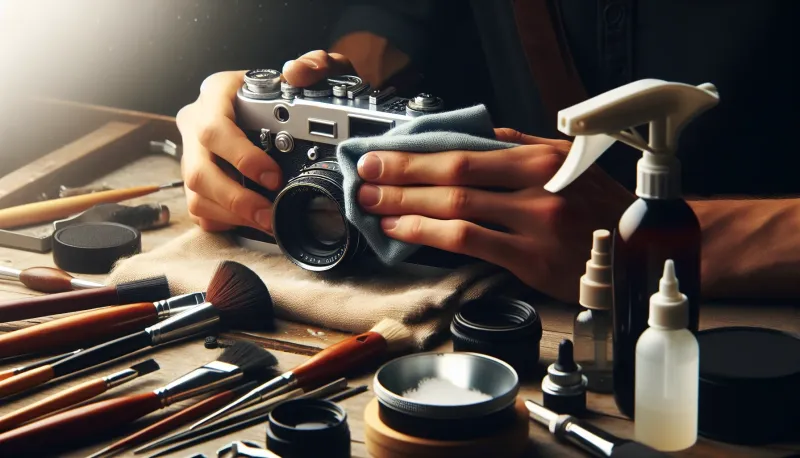
Quick Summary
Regular camera maintenance prevents 90% of common failures and costs just in basic supplies. We've been processing film at Kubus Photo Service since 1994, and in our experience, we've seen properly maintained cameras from the 1960s produce images indistinguishable from new equipment—while neglected cameras from the 2000s show light leaks on every roll. What actually happens inside a neglected camera? Lubricants dry out, shutter mechanisms slow, aperture blades become sticky, and batteries leak corrosive acid that destroys circuits. The reality most people don't realize is that a camera sitting unused deteriorates faster than one that's shot regularly. Clean your lenses with proper technique, replace light seals every 10-15 years before they fog your emulsion, remove batteries before any storage exceeding two weeks, store cameras in 35-50% relative humidity, and fire the shutter at all speeds monthly on stored cameras.
- Clean lenses using proper technique: blow dust first, then microfiber cloth with lens solution—never your shirt
- Replace light seals proactively every 10-15 years ( cost) before they crumble and ruin 5-10 rolls of film
- Remove batteries before any storage period exceeding 2 weeks—corrosion destroys + cameras in weeks
- Store cameras in 35-50% relative humidity—fungus thrives above 60% and causes permanent damage
- Fire the shutter at all speeds monthly on stored cameras to redistribute lubricants and prevent seizing
- Budget for professional CLA service every 5-10 years on heavily used cameras
- Never use canned compressed air—propellant residue damages optics and to professionally clean
- Basic maintenance kit and handles 95% of preventive care needs
Regular maintenance transforms unreliable old cameras into dependable tools that shoot flawlessly for decades. Clean your lenses properly using the blow-then-wipe method, replace light seals every 10-15 years before they fail and fog your film's emulsion, store equipment in 35-50% humidity environments, and exercise shutter and aperture mechanisms monthly to redistribute lubricants. These simple practices prevent 90% of common failures and cost just in basic supplies that last for years.
At Kubus Photo Service, we've been developing film in our Brooklyn lab since 1994. Over thirty years, we've seen the results of both excellent and terrible camera care—and the difference is dramatic. We've processed film from properly maintained cameras manufactured in the 1950s that produce images indistinguishable from brand new equipment. We've also seen neglected cameras from the 2000s show light leaks, sticky mechanisms, and fungus damage on every single roll. The difference isn't the camera's age—it's the maintenance it received.
Understanding What Fails and Why: The 5 Critical Failure Points
Film cameras fail in predictable ways. Every component has an expected lifespan and known failure modes. Understanding these failure patterns helps you focus maintenance efforts where they actually matter most.
Camera Failure Quick Reference Table
Light seals (Failure Rate by Age: 95% fail by year 15) — Warning Signs: Orange/red frame edges, foggy exposures, Prevention Cost: DIY kit, Professional Repair Cost: professional
Lubricants (Failure Rate by Age: 80% degraded by year 20) — Warning Signs: Slow shutter speeds, stiff focus ring, Prevention Cost: Monthly exercise routine, Professional Repair Cost: full CLA
Battery contacts (Failure Rate by Age: 60% corroded after leak) — Warning Signs: No meter function, erratic readings, Prevention Cost: Remove batteries when storing, Professional Repair Cost: + depending on damage
Fungus in lenses (Failure Rate by Age: 40% if stored above 60% humidity) — Warning Signs: Visible haze, web patterns on glass, Prevention Cost: silica gel packs, Professional Repair Cost: + or irreparable
Shutter mechanism Failure Rate by Age: 30% worn at 50,000+ actuations — Warning Signs: Inconsistent exposure timing, Prevention Cost: Regular CLA service, Professional Repair Cost: curtain/blade replacement
Light Seals: The #1 Problem We See Every Single Week
We've processed thousands of rolls with light leak damage over the years, and the pattern is always the same: the photographer had no idea their seals had failed until they saw the telltale orange or red edges on their developed scans. The foam seals around your camera's film door degrade over time—it's not a question of if they'll fail, but when.
A common mistake we see is photographers waiting until they notice light leaks on their photos—but by then, they've already ruined several rolls of irreplaceable images. Proactive replacement every 10-15 years in materials and takes about an hour of careful work, while waiting for visible failure means ruined vacation photos, wedding shots, or other images you can never recreate.
Seal lifespan varies significantly by climate and storage conditions:
- Humid climates (above 60% average humidity): 8-10 years typical lifespan
- Moderate climates (40-60% humidity): 12-15 years typical lifespan
- Dry climates (below 40% humidity): 15-20 years typical lifespan
When seals fail, they become sticky, tacky, crumbly, or completely disintegrate into dust. Seal debris falls into the camera body, contaminating shutter mechanisms, scratching your film's emulsion as it advances, and causing light to leak around the film door edges. We strongly recommend replacing seals proactively every 10-15 years rather than waiting for visible damage.
Lubrication Breakdown: Why Used Cameras Feel "Gunky"
Camera lubricants evaporate, migrate to places they shouldn't be, and break down chemically over time. A common mistake we see is people storing cameras "safely" in cases for years without ever firing the shutter or cycling the controls—this is actually worse for the mechanism than regular use because lubricants need movement to stay distributed properly.
What happens as lubricants degrade:
- Shutter mechanisms slow down as oil thickens or dries out completely
- Aperture blades become sticky as lubricant migrates onto blade surfaces where it doesn't belong
- Focus rings become stiff or gritty as helicoid grease dries and loses viscosity
- Film advance becomes rough as winding mechanism lubricants break down
- Mirror dampers harden causing slap and vibration issues in SLRs
The reality most people don't realize is that regularly used cameras often outlast carefully stored ones. Movement distributes lubricants, keeps mechanisms from seizing, and prevents the buildup of gunk in one location. At our Brooklyn lab, we recommend shooting at least a roll every few months to keep everything moving smoothly—your camera will thank you.
Battery Corrosion: The Camera Killer
Batteries leak. It's not a matter of if, but when and how badly. The chemicals released are highly corrosive and electrically conductive—they destroy electronic circuits and eat through metal contacts within weeks of initial leakage.
Over the years at our Brooklyn lab, we've seen hundreds of cameras worth + rendered completely worthless by worth of leaked battery acid. Cameras like the Olympus OM-2, Nikon FE2, Canon AE-1, and countless other classics have been destroyed because someone left batteries installed during storage. The fix takes just 30 seconds: remove the batteries before storing your camera.
Battery corrosion progression:
- Week 1-2: White or green deposits form on contacts
- Week 3-4: Corrosion spreads to circuit traces
- Month 2-3: Electrical connections fail permanently
- Month 3+: Structural damage to battery compartment
Fungus: The Silent Collection Destroyer
Lens fungus thrives in warm, humid, dark environments—which describes exactly the conditions inside a closed camera bag stored in a closet. Here's what makes fungus so insidious and dangerous:
- Fungal spores are everywhere in the air—they only need 60%+ humidity and darkness to colonize and grow
- Fungus etches into lens coatings permanently over time, causing damage that cannot be reversed even after cleaning
- Fungus spreads between lenses stored together—one infected lens in a camera bag can contaminate your entire collection within months
- Early-stage fungus is invisible to casual inspection—by the time you see it, damage is already occurring
In our experience processing film for photographers with extensive collections, prevention is genuinely 10x easier and cheaper than cure. A pack of silica gel desiccant can save a ,000+ lens collection from permanent damage.
Shutter Mechanism Wear: The Eventual Inevitability
Shutters have finite lifespans measured in actuations. A camera rated for 100,000 actuations will eventually need shutter service, and the warning signs are subtle until they become obvious problems affecting every frame.
Shutter wear indicators:
- Inconsistent timing (some 1/500s exposures are clearly darker than others)
- Slow speeds running noticeably slow (your 1 second sounds like 2+ seconds)
- Capping or partial frame darkening at high speeds
- Visible hesitation or stuttering during firing
Essential Cleaning Supplies: Building Your Maintenance Kit
Invest in proper supplies rather than improvising with household items—the wrong technique or materials can cause more damage than years of neglect.
Complete Maintenance Kit Checklist
Rocket blower (Primary Purpose: Remove loose particles safely) — Approximate Cost: , Notes: Never substitute canned air
Lens brush or LensPen (Primary Purpose: Dust removal from optical surfaces) — Approximate Cost: , Notes: Dedicated to camera use only
Microfiber cloths (5-pack minimum) (Primary Purpose: Lens and body cleaning) — Approximate Cost: , Notes: Wash regularly, replace yearly
Lens cleaning solution (Primary Purpose: Smudge and fingerprint removal) — Approximate Cost: , Notes: Alcohol-free formulas preferred
Isopropyl alcohol 90%+ (Primary Purpose: Contact and adhesive cleaning) — Approximate Cost: , Notes: Don't use lower concentrations
Cotton swabs (200-pack) (Primary Purpose: Detail cleaning in tight areas) — Approximate Cost: , Notes: Use high-quality, tight-wound swabs
Light seal kit (Primary Purpose: Seal replacement material) — Approximate Cost: , Notes: Camera-specific kits available
Naphtha or lighter fluid (Primary Purpose: Old adhesive removal) — Approximate Cost: , Notes: Use in ventilated area only
Silica gel packs (Primary Purpose: Humidity control in storage) — Approximate Cost: , Notes: Rechargeable versions available
Total basic kit cost (Approximate Cost: ****) — Notes: Lasts multiple years Critical warning: Never use canned compressed air on camera equipment. The propellant leaves residue on optical surfaces that to professionally remove, and the high-pressure blast can drive particles deeper into mechanisms where they cause abrasion damage. Always use a manual rocket blower instead.
Mail-In Your Film From Anywhere
Ship your film to our Brooklyn lab and get professional scans delivered to your inbox. Free shipping on 4+ rolls.
Lens Cleaning: Proper Technique That Won't Cause Damage
More lenses are damaged by improper cleaning than by dust—we see this pattern every week at Kubus. A common mistake we see is aggressive, frequent cleaning that gradually scratches coatings. The goal should be cleaning only when actually necessary, not cleaning for the sake of cleaning.
When Should You Actually Clean Your Lens?
Minor dust on lens surfaces has negligible impact on image quality. A few specs won't show in your photographs—don't obsess over perfect cleanliness. Clean only when you see:
- Fingerprints or oily smudges (affects contrast by 5-15% and shows in backlit situations)
- Visible haze or film across the surface
- Debris that won't remove with gentle blowing
- Water spots, salt spray residue, or sticky substances
- Fungal growth (requires professional attention for internal growth)
Over-cleaning causes more wear than it prevents. Each cleaning cycle, even done correctly, creates microscopic wear on coatings. Clean when needed, not on a schedule.
The 4-Step Cleaning Process
Step 1: Remove loose particles first (critical—never skip this step!)
Hold lens face-down so gravity helps particles fall away from the surface. Use a rocket blower to puff air across the surface from an angle, not straight on.
Why this step matters so much: Wiping a dusty lens grinds particles across the coating, causing micro-scratches that accumulate over time into visible damage. A single cleaning session on a very dusty lens can cause more coating wear than years of normal use.
Step 2: Apply solution to cloth (never directly to lens surface)
Place 1-2 drops of lens cleaning solution on your microfiber cloth—never apply solution directly to the lens. Direct application can cause solution to seep into the lens barrel around the edges, potentially reaching internal elements where it causes permanent damage.
Step 3: Wipe in gentle circular motions from center outward
Starting at the center of the lens, wipe in a gentle spiral pattern toward the edges using very light pressure. Heavy pressure accomplishes nothing and increases wear risk.
Step 4: Dry and buff with clean portion of cloth
Use a dry, clean portion of the same microfiber cloth to remove moisture and polish the surface to a streak-free finish.
Body Cleaning and Care: Beyond Just the Lens
Film Chamber Cleaning Between Rolls
Clean the film chamber every 10-20 rolls to prevent debris from scratching film as it advances. Use a rocket blower to remove loose particles. Wipe the pressure plate gently with a dry microfiber cloth.
Inspect the film rails carefully—the raised edges that guide film across the aperture gate. These rails should be perfectly smooth and completely free of debris. Any scratches or debris on the film rails will transfer visible marks to every single roll you shoot through that camera until the problem is addressed.
Mirror Box Cleaning (SLR Cameras)
The mirror and focusing screen in SLR cameras are extremely delicate components. Blow loose particles away with a rocket blower only. Never touch the mirror surface with anything—even a microfiber cloth can scratch the front-surface mirror coating.
Unlike bathroom mirrors where the reflective coating is protected behind glass, camera mirrors have the reflective coating on the front surface for optical reasons. This makes them extremely vulnerable to scratches and abrasion. If your mirror is dirty enough to need more than blowing, it needs professional cleaning.
Battery Contact Cleaning and Maintenance
Clean battery contacts whenever you change batteries, even if they look clean. Use a cotton swab dampened with 90%+ isopropyl alcohol and allow to dry completely before inserting new batteries.
If you see white, blue, or green deposits (early corrosion):
- Remove all battery residue immediately with an alcohol-dampened swab
- For stubborn crystallized corrosion, use a clean pencil eraser with gentle pressure
- Follow with alcohol to remove any eraser residue
- Check for damage to spring contacts and circuit traces
- Test camera function before trusting it for important shots
Light Seal Replacement: The Most Impactful DIY Maintenance
Replacing light seals is the single most impactful DIY maintenance you can perform on a vintage camera—it takes about an hour, in materials, and prevents the #1 cause of ruined photos we see at our film developing service.
How to Assess Your Camera's Seal Condition
Good (Visual Signs: Solid black, uniform thickness) — Touch Test Result: Springs back instantly when pressed, Action Required: None needed, check annually
Aging (Visual Signs: Slightly compressed, minor tackiness) — Touch Test Result: Slow return (2-3 seconds), Action Required: Plan replacement within 6 months
Deteriorating (Visual Signs: Sticky, tacky surface, visible compression) — Touch Test Result: Stays compressed permanently, Action Required: Replace within next month
Failed (Visual Signs: Crumbly, flaking, disintegrating) — Touch Test Result: Falls apart when touched, Action Required: Replace immediately before shooting
Gone (Visual Signs: Only residue and old adhesive visible) — Touch Test Result: N/A—nothing left to test, Action Required: Replace before loading any film
Complete Removal and Installation Process
Removal phase:
- Use a plastic spudger or wooden toothpick to scrape out old foam carefully without scratching metal
- Dampen a cotton swab with naphtha (lighter fluid) to dissolve old adhesive—allow 30-60 seconds to work
- Remove all adhesive residue until metal channels are completely clean
- Allow to dry completely (5-10 minutes) before installing new seals
Installation phase:
- Measure and cut new seal strips to exact length—slightly long is better than short, as you can trim excess
- Peel adhesive backing in small sections as you work along the channel
- Position carefully and press into place—adhesive is strong, so you generally only get one attempt at positioning
- Press firmly along entire length to ensure full adhesive contact
- Close film door gently—foam should compress 10-20% when door is closed properly
The flashlight test for verification: In a completely dark room, shine a bright flashlight or phone light inside the closed camera body. Any visible light leaking around the door edges indicates gaps in your seal installation. A test roll before shooting anything important is wise—bring it to our film developing and scanning service to identify any remaining leak issues before they ruin important images.
Proper Storage Practices: Where Most Damage Actually Occurs
How you store cameras between uses has more impact on long-term reliability than any other maintenance factor—including how often you shoot or clean.
Humidity Control: The #1 Storage Consideration
Fungus thrives between 60-80% relative humidity in dark environments—exactly the conditions inside a camera bag in a closet. Below 50% humidity, fungal growth essentially stops. Store all camera equipment at 35-50% relative humidity for optimal preservation.
Electronic dry cabinet Approximate Cost: + — Effectiveness Rating: Excellent (precise control), Best For: Large collections, humid climates
Sealed container + silica gel + hygrometer Approximate Cost: — Effectiveness Rating: Very good (requires monitoring), Best For: Small-medium collections
Silica gel packets in camera bag Approximate Cost: — Effectiveness Rating: Good (limited control), Best For: Active shooters who rotate equipment
Nothing (ambient storage) (Approximate Cost: ) — Effectiveness Rating: Poor in humid climates, Best For: Only acceptable in dry climates <40%
Temperature and Battery Storage Rules
Temperature extremes and fluctuations cause their own damage independent of humidity:
- Avoid high heat (above 90°F/32°C): Accelerates lubricant migration and breakdown
- Avoid freezing temperatures (below 32°F/0°C): Can crack lubricants and damage seals
- Avoid rapid temperature swings: Causes condensation inside camera body
- Ideal storage temperature: 60-75°F (15-24°C) with minimal fluctuation
Always remove batteries before storing cameras for more than two weeks. No exceptions. Even batteries marketed as "leak-proof" can and do corrode over extended storage periods. The 30 seconds it takes to remove batteries can save a camera.
Exercising Stored Equipment: The Monthly 5-Minute Routine
Mechanisms that sit idle deteriorate faster than those used regularly. For cameras in storage that aren't being shot regularly, spend 5 minutes monthly performing this maintenance routine:
- Fire the shutter at all speeds (1 second through 1/1000) to redistribute lubricants across mechanism
- Cycle the aperture ring through all f-stops (wide open to minimum aperture) multiple times
- Wind and release the film advance lever 5-10 times without film loaded
- Cycle lens focus rings smoothly from minimum focus to infinity and back several times
- Check that all controls move freely without sticking or grinding
This routine keeps lubricants distributed, prevents mechanisms from seizing, and helps you identify developing problems before they become serious failures.
Preventive Maintenance Schedule: Your Complete Calendar
Before Each Shooting Session (2 minutes maximum)
- Check battery level or install fresh batteries
- Inspect lens front and rear surfaces for debris
- Verify film door closes and latches properly
- Confirm all controls move freely without sticking
- Check meter function by pointing at bright and dark areas
Monthly Maintenance (15 minutes)
- Clean battery contacts with alcohol swab
- Wipe exterior surfaces with dry microfiber cloth
- Clean film chamber with rocket blower (no cloth)
- Check light seals visually for deterioration
- Exercise all shutter speeds on stored cameras
- Verify silica gel in storage containers is still active (indicator color)
Annual Maintenance (30 minutes per camera)
- Thorough exterior cleaning including crevices
- Exercise all controls through their full range multiple times
- Inspect light seals closely with flashlight test
- Check meter accuracy against smartphone light meter app
- Evaluate focus accuracy with test shots at various distances
- Assess lens condition for developing haze or fungus
Every 5-10 Years
- Professional CLA (clean, lubricate, adjust) for heavily used cameras:
- Proactive light seal replacement even if seals appear okay: DIY, professional
- Comprehensive shutter timing check with calibration if needed
- Rangefinder or focus screen calibration for cameras showing alignment issues
When to Seek Professional Service: Knowing Your Limits
Signs Your Camera Needs a Professional CLA
Shutter speeds inconsistent shot-to-shot (What It Indicates: Lubricant breakdown in shutter mechanism) — Can You DIY?: No—requires disassembly
Slow speeds running noticeably slow (What It Indicates: Oil thickened or dried on slow speed escapement) — Can You DIY?: No—requires specialized service
Mirror return sluggish in SLR (What It Indicates: Mirror damper deterioration) — Can You DIY?: No—requires replacement parts
Film advance stiff or rough (What It Indicates: Helicoid grease dried or contaminated) — Can You DIY?: No—requires complete tear-down
Light leaks appearing on developed film (What It Indicates: Seal failure) — Can You DIY?: Yes—see detailed section above
Meter reads inconsistently or erratically (What It Indicates: Electrical issues in metering circuit) — Can You DIY?: No—requires electronic diagnosis
Repairs That Are Beyond DIY Capability
Some maintenance tasks require professional tools, training, and parts that aren't available to consumers:
- Internal fungus cleaning: Requires complete lens disassembly and specialized cleaning
- Aperture blade cleaning: Delicate blades bend and damage easily during handling
- Rangefinder calibration: Requires specialized optical alignment tools and expertise
- Mirror alignment in SLRs: Affects focus accuracy through viewfinder
- Shutter curtain replacement: Tensioning is camera-specific and requires calibration
- CLA (clean, lubricate, adjust): Full service of all mechanical systems
Frequently Asked Questions
How often should I clean my camera lenses?
Clean only when you see visible contamination—fingerprints, oily smudges, water spots, or debris that won't blow off. Some photographers go months between cleanings, and that's completely fine. Over-cleaning causes more wear than moderate dust.
My camera has been stored for years without use. Is it safe to shoot?
Inspect carefully before loading valuable film. Check for battery corrosion (remove and examine contacts), light seal deterioration (touch test), and visible fungus (hold lens to light). Fire the shutter at all speeds and listen for hesitation. A test roll reveals problems visual inspection might miss—bring it to our film developing service to identify issues before shooting anything important.
How do I know if my camera needs a professional CLA?
Slow shutter speeds are the most obvious indicator—if your 1 second exposure sounds like 2+ seconds, lubricants have thickened and need professional attention. Inconsistent timing between consecutive firings also indicates service is needed. Stiff controls and gritty focus rings suggest dried lubricants throughout.
What's the most common maintenance mistake you see?
In our experience processing hundreds of thousands of rolls over thirty years, waiting until light seals fail before replacing them is the #1 mistake. People bring us roll after roll with characteristic orange edges saying "I had no idea my seals were bad"—but by then they've ruined irreplaceable images.
How much should I budget for camera maintenance annually?
- Supplies (one-time purchase): for complete kit
- Consumables (annual): for replacement silica gel, swabs, cleaning supplies
- CLA service (every 5-10 years per camera): depending on camera complexity
- Light seal kits (every 10-15 years per camera): for DIY materials
For a single camera used regularly, budget approximately per year averaged over time. Collectors with multiple cameras will spend more.
Can I use household cleaning products on my camera?
No. Household glass cleaners contain ammonia and other chemicals that damage lens coatings. Paper towels and tissues leave fibers and can scratch coatings. Use only products specifically designed for optical equipment.
The Payoff: Decades of Reliable Service
Proper maintenance transforms vintage cameras into reliable tools that can outlast modern electronic equipment. At Kubus Photo Service, we regularly develop film from cameras manufactured in the 1950s through 1980s that perform flawlessly because their owners maintained them properly throughout the decades. We've seen cameras with 60+ years of continuous service still producing beautiful images.
The investment is minimal compared to the value: in supplies that last years, perhaps an hour per camera per year in actual maintenance time. The return is cameras that work correctly every time you pick them up, photographs without light leaks or mechanical failures ruining irreplaceable moments, and equipment that may well outlast you to serve the next generation of film photographers.
When your well-maintained camera produces film that needs developing, we're here to help. At Kubus Photo Service, we've been processing all common film formats on professional Noritsu equipment since 1994. Our typical turnaround is 4-6 business days, with rush same-day or next-day service available when you need it. Visit our mail-in lab page to get started from anywhere in the country.
If you're still learning film photography, our guide on first roll mistakes can help you avoid common pitfalls, and our beginner camera guide helps you find gear that's worth maintaining for decades to come.
Kubus Photo Service is a family-run film lab in Williamsburg, Brooklyn, developing film since 1994. We're a family-run lab that's helped countless photographers keep their equipment producing great images for decades—and we've seen what works and what doesn't when it comes to camera care.
Related Articles
How to Test a Used Film Camera Before Buying: The Complete Inspection Guide
A thorough pre-purchase inspection can save you hundreds on repairs. Learn the exact tests professional camera technicians use to evaluate shutters, meters, lenses, and light seals before you hand over your money.
Best Film Cameras for Beginners: An Honest 2026 Buying Guide
Choosing your first film camera matters more than any other gear decision. This guide covers the camera types, specific models worth buying, common pitfalls to avoid, and how to test a camera before committing.
First Roll of Film Mistakes: What Went Wrong and How to Fix It
Your first roll came back and something's wrong. Blank frames, light leaks, blur, weird colors. This diagnostic guide identifies the most common first-roll problems, explains what caused them, and tells you how to avoid them next time.
Ready to Develop Your Film?
We're a family-run film lab in Williamsburg, Brooklyn, developing film since 1994. Whether you drop off in store or mail your rolls from anywhere in the US, we treat every frame with care.
How to Mail In Film for Developing: Complete Step-by-Step Guide
Learn exactly how to safely mail your film for professional developing. Step-by-step guide covering packing, shipping options, what to expect, and how to get the best results from a professional film lab.
Read the Complete Guide