
What ISO Film Should I Use? The Complete Guide to Film Speed Selection
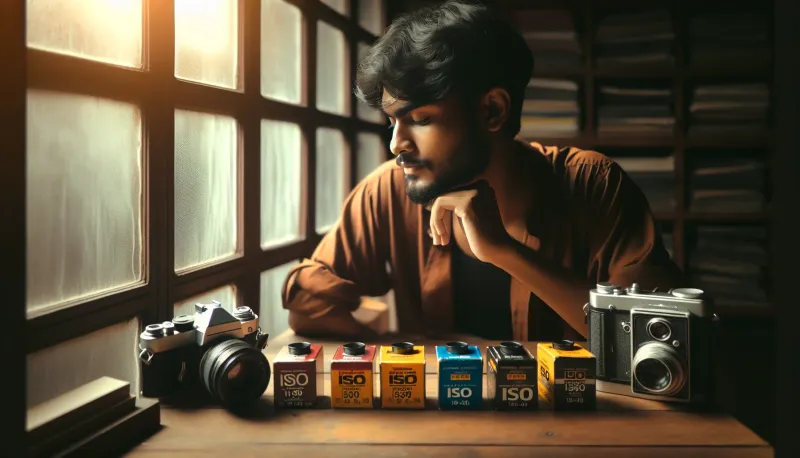
Quick Summary
ISO 400 is the most versatile choice for beginners and experienced shooters alike. In our experience processing thousands of rolls monthly, we've seen that ISO 400 handles everything from bright outdoor light to shaded interiors, produces pleasing grain that scans beautifully, and forgives exposure errors in both directions. Use ISO 100-200 for bright outdoor light and finest grain, ISO 400 for mixed conditions and general shooting, and ISO 800+ when shooting indoors or in low light without flash.
- ISO 100-200: Bright sunlight only, finest grain, sharpest results, requires good light
- ISO 400: Best all-around choice (90% of situations), handles sun to open shade, moderate grain
- ISO 800: Indoor window light, overcast days, golden hour, noticeable but pleasing grain
- ISO 1600-3200: Concert venues, night streets, indoor sports - grain becomes part of aesthetic
- Film tolerates overexposure well: ISO 400 rated at 200 produces finer grain
ISO 400 is the most versatile film speed for beginners and experienced shooters alike. It handles everything from bright outdoor light to shaded interiors, produces pleasing grain that scans beautifully, and gives you flexibility when light conditions change unexpectedly. We've seen this confirmed across thousands of rolls we process every month at Kubus Photo Service.
The question we hear most often from photographers just getting into film is simple: what ISO should I buy? The answer depends on how you shoot, where you shoot, and what look you want. But if you're unsure, ISO 400 covers 90% of situations. This guide breaks down everything you need to know.
Understanding ISO: What Film Speed Actually Means
ISO measures how sensitive film is to light. The number comes from the International Organization for Standardization, which created the system we use today by combining the older ASA (American) and DIN (German) standards in 1974.
Lower numbers mean less sensitivity. ISO 100 film needs more light to create a proper exposure than ISO 800 film. This relationship is linear and predictable: ISO 200 is exactly twice as sensitive as ISO 100, and ISO 400 is twice as sensitive as ISO 200.
In practical terms, if you're shooting ISO 100 film on a sunny day at f/16 and 1/125 second, switching to ISO 400 film lets you shoot at f/16 and 1/500 second, or f/8 and 1/125 second. That extra sensitivity buys you flexibility.
The Grain Trade-Off
Higher sensitivity comes with a cost: grain. Film captures light using silver halide crystals suspended in gelatin. Faster films use larger crystals that capture photons more efficiently, but these larger crystals create visible texture in your images.
50-100 (Grain: Nearly invisible) — Best for: Landscapes, studio, maximum enlargement. Maximum print size: 30x40" and beyond
200 (Grain: Minimal) — Best for: Outdoor portraits, travel. Maximum print size: 20x30"
400 (Grain: Subtle, pleasing) — Best for: General purpose, mixed conditions. Maximum print size: 16x20"
800 (Grain: Noticeable) — Best for: Low light, events. Maximum print size: 11x14"
1600-3200 (Grain: Prominent) — Best for: Concerts, night, artistic. Maximum print size: 8x10" ISO 100 films like Kodak Ektar produce grain so fine it essentially disappears in normal-sized prints. The crystals are tiny, tightly packed, and uniform. You can enlarge these negatives to 30x40 inches before grain becomes apparent.
ISO 400 films strike a balance. Kodak Portra 400 and Kodak Gold 200 show subtle grain that adds character without overwhelming fine details. Most photographers find this level of grain pleasing rather than distracting.
ISO 800 and above show increasingly prominent grain. Some photographers love this look. Others find it distracting. The key is understanding what you're getting before you buy.
ISO 100-200: The Daylight Films
These are your fine-grain, maximum-sharpness options. They excel in one specific situation: bright daylight.
When ISO 100-200 Works Best
- Beach and snow photography: These environments reflect enormous amounts of light. ISO 100 gives you comfortable shutter speeds even at small apertures.
- Landscape photography with a tripod: When your camera is locked down and your subject isn't moving, slow shutter speeds don't matter. ISO 100 maximizes detail.
- Studio work with strobes: Powerful studio lights (400+ watt-seconds) output enough energy to properly expose slow films.
- Sunny travel photography: Reliably bright destinations like the Mediterranean or American Southwest.
The Limitations You Need to Know
A common mistake we see is photographers bringing only ISO 100 film on trips, then struggling when conditions change. ISO 100-200 films struggle the moment light levels drop:
- Open shade on a sunny day might require 1/60 second at f/2.8 with ISO 100
- Indoor photography becomes nearly impossible without flash
- Late afternoon on overcast days requires impractically slow shutter speeds
Specific Films to Consider
Kodak Ektar 100: Delivers the finest grain of any color negative film currently made. Colors are saturated, almost slide-film-like. Skin tones run cool and need some warmth added in scanning. This is a landscape and product photographer's film.
Kodak Gold 200: Offers a warmer palette with slightly more grain. It's affordable, widely available, and produces that classic film look people associate with family photos from the 1990s.
Fujifilm 200: Gives you fine grain with Fuji's characteristic rendering: slightly cooler shadows, pleasing greens, and smooth skin tones.
Ilford Pan F Plus 50: An extreme example for black and white shooters. The grain is essentially invisible, but you need serious light to use it effectively.
ISO 400: The Do-Everything Film Speed
If you could only ever shoot one film speed, ISO 400 would be the right choice. It handles the widest range of lighting conditions without forcing difficult compromises.
Why ISO 400 Works So Well
The math works in your favor. On a sunny day, ISO 400 at f/16 gives you 1/500 second. That's plenty fast for street photography, action, or handheld shooting with longer lenses. You can stop down for depth of field or open up for shallow focus without running into limitations.
When clouds roll in, you still have workable shutter speeds. Overcast conditions that would have ISO 100 shooters at 1/30 second give you 1/125 second with ISO 400. The reality is that this difference often separates camera shake from sharp images.
Indoors near windows, ISO 400 remains usable. You might be at 1/60 second and f/2.8, but that's manageable for portraits and still life. ISO 100 would require a tripod or flash.
The Grain Character of ISO 400
Modern ISO 400 films show grain that most photographers describe as pleasant. It's visible if you look for it, but it doesn't overwhelm the image. When you process these films through a good scanner, the grain adds texture without destroying detail.
Over the years, we've seen professional portrait photographers shoot Portra 400 for decades precisely because the grain enhances rather than detracts. It looks organic in a way digital noise never does.
ISO 400 Films Worth Knowing
Kodak Portra 400: The professional standard for portraits and weddings. The color palette flatters skin tones across all ethnicities. It handles overexposure remarkably well, with some photographers intentionally rating it at ISO 200 or even ISO 100 for more shadow detail and even finer grain.
Kodak Ultramax 400: Costs less than Portra but shares similar technology. Colors are punchier and more saturated. Excellent for everyday shooting when you want a classic consumer film look.
Kodak Gold 200: Falls between the consumer and professional lines. Recent reformulations have improved it significantly. Many photographers find it hard to distinguish from Portra in good light.
Fujifilm Superia X-TRA 400: Offers Fuji's color science at the ISO 400 speed point. Greens are particularly beautiful, and the film handles mixed lighting better than some alternatives.
Ilford HP5 Plus 400: The black and white workhorse. It pushes well to ISO 800 or even 1600, handles a wide range of development approaches, and produces gorgeous midtones.
Kodak Tri-X 400: Has been a photojournalist favorite since 1954. The grain is more pronounced than HP5 but highly characteristic. Generations of photographers have built careers on this emulsion.
Mail-In Your Film From Anywhere
Ship your film to our Brooklyn lab and get professional scans delivered to your inbox. Free shipping on 4+ rolls.
ISO 800: The Low-Light Solution
When available light drops below what ISO 400 can handle comfortably, ISO 800 films give you an extra stop of sensitivity.
Where ISO 800 Shines
- Indoor events without flash: Weddings, parties, concerts, gallery openings often prohibit flash
- Golden hour and blue hour: That magic 30-60 minutes before sunset and after is beautiful but dim
- Overcast days with moving subjects: Sports, children playing, pets running
- Street photography in shade: Urban environments with tall buildings create deep shadows
The Grain Reality
ISO 800 grain is visible in any reasonably sized print. It's not objectionable to most viewers, but it's definitely there. The character varies by film stock.
Kodak Portra 800 manages grain remarkably well for its speed. The grain structure is tight and uniform. In our experience, many photographers can't distinguish Portra 800 from Portra 400 in normal 4x6 or 5x7 prints.
Cinestill 800T has a different character. Because it's derived from motion picture film with the remjet layer removed, it shows halation (red glow) around bright light sources and has a distinct look that photographers either love or avoid.
Films at This Speed Point
Kodak Portra 800: Remains the gold standard. Handles mixed lighting well, pushes to 1600 in a pinch, and maintains pleasing color even in challenging conditions.
Cinestill 800T: Tungsten-balanced, meaning it's designed for indoor artificial light. Under daylight, it shifts cyan/blue. Some photographers use this creatively. The halation effect around highlights has become iconic.
Ilford Delta 3200: Rated at 3200 but actually closer to ISO 1000-1250 in normal development. The grain is pronounced but appealing for certain subjects.
Kodak P3200 TMAX: The fastest black and white film commonly available. Real-world speed is around ISO 800-1000 at box development, but it pushes remarkably well to ISO 3200 and beyond.
ISO 1600-3200 and Beyond: Extreme Low Light
These films exist for situations where nothing else works. Concert halls, night streets, dimly lit restaurants, indoor sports venues with bad lighting.
Realistic Expectations
Film grain at ISO 1600 and above becomes a defining characteristic of the image. Fine detail disappears into texture. Colors become less accurate. Contrast can increase or decrease depending on the film and development.
Some photographers embrace this aesthetic. The grain creates a mood that digital cameras can't replicate authentically. Others find it distracting and prefer to add light rather than push film speed.
Pushing Film as an Alternative
You don't always need to buy high-ISO film. Pushing means rating a slower film at a higher ISO and asking your lab to extend development time to compensate.
Ilford HP5+ (Normal Rating: 400) — Push +1: 800 (excellent), Push +2: 1600 (good), Push +3: 3200 (acceptable)
Kodak Tri-X (Normal Rating: 400) — Push +1: 800 (excellent), Push +2: 1600 (good), Push +3: 3200 (acceptable)
Portra 400 (Normal Rating: 400) — Push +1: 800 (minimal loss), Push +2: 1600 (noticeable grain), Push +3: Not recommended When you send pushed film to a lab like ours, you need to mark the roll clearly. Write "Push +1" for one stop (400 to 800), "Push +2" for two stops (400 to 1600). We adjust development accordingly.
Pushed film shows increased contrast and grain compared to native high-ISO stocks. Whether this looks better or worse depends on the subject and your taste.
Practical Scenarios: Matching Film to Situation
Theory only takes you so far. Here's how these choices play out in real shooting situations.
Outdoor Portrait Session, Sunny Day
ISO 100-200 gives you the finest grain and lets you use wider apertures for shallow depth of field without overexposure. If your camera's top shutter speed is 1/1000 second and you want to shoot at f/2.8, ISO 100 makes that possible. ISO 400 might require neutral density filters or smaller apertures.
Street Photography in a City
ISO 400 handles everything from sunlit sidewalks to shadowed alleyways. You won't need to change film when you walk from a bright plaza into a covered market. If you're specifically shooting at night or in predominantly shaded areas, consider ISO 800.
Indoor Family Gathering
ISO 800 minimum, and ISO 400 pushed to 800 works well too. Window light might give you enough exposure for ISO 400, but as evening approaches and artificial lights come on, you'll need the extra sensitivity. Flash is always an option but changes the character of the images significantly.
Concerts and Live Music
ISO 1600-3200, or ISO 800 film pushed. Stage lighting creates extreme contrast, and venues rarely allow flash. You'll need fast lenses (f/2.8 or wider) combined with high-speed film. Accept that grain will be prominent and plan compositions that work with it.
Beach Vacation
ISO 200-400 handles most situations. Bright sun on sand provides abundant light, but you'll also shoot in beach bars, restaurants, and on evening walks. ISO 400 covers the range without requiring multiple film stocks.
Hiking and Landscape Photography
ISO 100-200 if you carry a tripod. ISO 400 if you shoot handheld. Mountain light can be intense, but forest shade drops light levels significantly. The flexibility of ISO 400 usually outweighs the marginal grain difference.
How ISO Affects Your Other Settings
Film speed doesn't exist in isolation. It interacts with aperture and shutter speed to determine your exposure.
The Exposure Triangle
Every stop of ISO sensitivity you gain can be traded for a stop of aperture or shutter speed. This creates options:
- Want deeper depth of field? Higher ISO lets you stop down while maintaining adequate shutter speed
- Want to freeze motion? Higher ISO enables faster shutter speeds at any given aperture
- Want shallower depth of field in bright light? Lower ISO lets you open up without overexposure
Working with Specific Lenses
If your fastest lens opens to f/2.8, ISO 400 gives you more usable range than ISO 100. The math: at f/2.8 in open shade, ISO 100 might require 1/30 second while ISO 400 allows 1/125 second.
With an f/1.4 lens, ISO 100 becomes more practical in lower light. That extra two stops of lens speed compensates for slower film.
Camera Limitations Matter
Older cameras with maximum shutter speeds of 1/500 or 1/1000 second constrain your options in bright light. ISO 400 at f/16 on a sunny day requires 1/500 second. ISO 100 would need 1/125 second, giving you more headroom before hitting the camera's limit.
Cameras with slower flash sync speeds (typically 1/60 to 1/125 second) affect how you use fill flash with different film speeds.
The Overexposure Question
Color negative film handles overexposure remarkably well. You can shoot ISO 400 film at ISO 200 or even ISO 100 and get usable, often beautiful results. The shadows open up, grain decreases slightly, and colors remain accurate.
Underexposure is less forgiving. Shadows lose detail permanently. Colors shift. Grain increases in the areas that were underexposed. When in doubt, err toward overexposure with negative film.
This tolerance means ISO 400 film can effectively cover the ISO 200-800 range in a pinch. Overexpose by a stop in bright light, underexpose by a stop in dim conditions, and you'll get printable results. What actually happens is the film's latitude acts as a buffer for your mistakes.
Making Your Decision
For most photographers starting out, ISO 400 is the right answer. It handles the widest variety of situations, produces grain that enhances rather than detracts, and forgives exposure errors in both directions.
Once you understand your shooting patterns, you can specialize. If you shoot mostly outdoors in good light, ISO 100-200 rewards you with finer grain. If you shoot mostly indoors or in low light, ISO 800 reduces stress.
We recommend many working photographers carry two film speeds: ISO 400 for general work and either ISO 100 for bright conditions or ISO 800 for dark ones. Having options means never missing a shot due to the wrong film.
Getting the Best Results from Any ISO
Proper exposure matters more than film speed for final image quality. An accurately exposed ISO 800 negative looks better than a badly underexposed ISO 100 negative.
Use a light meter or learn the Sunny 16 rule to nail your exposures. Review your results from each roll and adjust your approach.
Quality processing makes a difference too. Consistent development chemistry, proper temperature control, and careful scanning reveal what the film actually captured. When you send your film to Kubus Photo Service, we process every roll on calibrated Noritsu equipment with fresh chemistry. Our standard turnaround runs 4-6 business days depending on volume, with rush same-day or next-day service available when you need it faster.
The right ISO gets light onto your film. Proper processing turns that captured light into images you can share, print, and keep forever.
Frequently Asked Questions
What ISO film is best for beginners?
ISO 400 is the best choice for beginners. It handles outdoor sunlight through indoor window light, forgives exposure errors in both directions, and produces pleasing grain. Kodak Ultramax 400 or Kodak Gold 200 are affordable options to start with.
Can I use ISO 100 film indoors?
ISO 100 film requires very bright indoor conditions or a tripod for sharp handheld photos. Near a large sunny window, you might manage 1/60 second at f/2.8, but this limits your flexibility. Flash or ISO 400+ film works better for most indoor situations.
What's the difference between ISO 400 and 800 film?
ISO 800 film is twice as sensitive to light as ISO 400, allowing faster shutter speeds or smaller apertures in the same conditions. ISO 800 shows more grain than ISO 400, though modern films like Portra 800 manage this well. Use ISO 800 when shooting in lower light or when you need faster shutter speeds.
Does higher ISO mean lower quality?
Higher ISO means more visible grain, but this doesn't automatically mean lower quality. Many photographers prefer the look of ISO 800 grain for portraits and documentary work. Quality depends on proper exposure and processing more than ISO choice.
Should I push ISO 400 film or buy ISO 800?
Both approaches work. Native ISO 800 film (like Portra 800) handles the speed gracefully with optimized grain structure. Pushed ISO 400 film shows increased contrast and slightly different grain character. Try both and see which look you prefer. Pushing typically extra per roll.
What ISO for night photography without flash?
ISO 800 minimum for handheld night photography, and ISO 1600-3200 often necessary depending on available light. With a tripod, you can use any ISO since you can extend shutter speeds indefinitely. Many night photographers push ISO 400 film to 1600 for acceptable grain with good tonality.
Kubus Photo Service has developed and scanned film for photographers across the country since 1994. Ship your rolls to our mail-in film lab or visit our Williamsburg, Brooklyn location. Learn more about our film developing services or call us at (718) 389-1339.
Related Articles
Best Film for Beginners: The Honest Guide from 30 Years Behind the Counter
After developing film for beginners since 1994, we've seen every mistake and every triumph. Here's our no-nonsense guide to choosing your first film stocks, avoiding expensive pitfalls, and building a foundation that actually works.
How Much Does Film Developing Cost in 2026? Complete Price Guide
Film developing costs $12-25 per roll in 2026. Get the complete breakdown of drugstore vs. professional lab pricing for 35mm, 120, disposable cameras, and black and white film with honest advice on where to spend and where to save.
The Sunny 16 Rule Explained: Master Film Exposure Without a Light Meter
The Sunny 16 rule has helped photographers nail exposure for over a century. Learn this time-tested technique for estimating light levels, plus variations for every lighting condition from beach to overcast to shade.
Ready to Develop Your Film?
We're a family-run film lab in Williamsburg, Brooklyn, developing film since 1994. Whether you drop off in store or mail your rolls from anywhere in the US, we treat every frame with care.
How to Mail In Film for Developing: Complete Step-by-Step Guide
Learn exactly how to safely mail your film for professional developing. Step-by-step guide covering packing, shipping options, what to expect, and how to get the best results from a professional film lab.
Read the Complete Guide